An uncommon condition is recurrent respiratory papillomatosis (RRP), in which benign growths resembling warts, called papillomas, appear on the airway lining. These most frequently occur on the vocal cords of the voice box (larynx), but can also occur in other parts of the airway. HPV infection causes papillomas. Typically, the cause of the illness is types 6 or 11 of the Human Papillomavirus (HPV). The papillomas are non-cancerous, but there is a tendency for them to recur frequently after surgical treatment and for them to affect the person’s ability to speak, swallow, and breathe. RRP can affect individuals of any age, although RRP in children commonly manifests at a very early age. Symptoms can include breathlessness or stridor (noisy breathing), a constant cough, or hoarseness. If the papillomas spread, they can eventually block the airway and significantly reduce the available breathing passage. As the disease is generally recurrent, children will need ENT review on a long-term basis and repetitive treatment. Maintaining safe airways, preserving the voice, and improving quality of life through effective airway management are important.
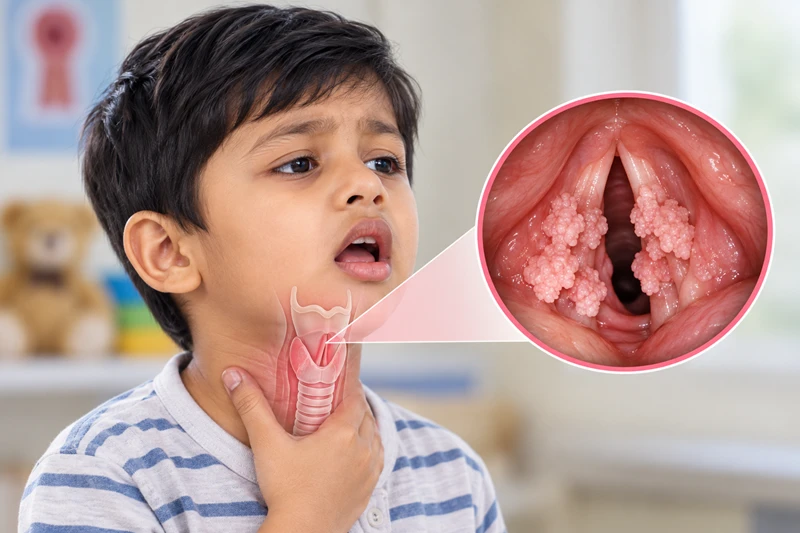
Recurrent Respiratory Papillomatosis is an HPV-driven illness that affects the airway.
Common Risk Factors Include:
The virus causes normal airway tissue to become abnormal and to grow over the vocal cords or along other airway surfaces.
Usually, symptoms appear gradually and worsen over time as the papillomas progressively enlarge.
Common Symptoms Include:
Many symptoms persist after initial treatment due to the regrowth of papillomas.
The illness can be categorized into several types, depending on age and the airway region affected.
The choice of treatment and need for continued follow-up depend on the classification of the RRP.
A clear diagnosis must be established to effectively manage the patient’s airway.
Diagnostic Methods Include:
Currently, there is no cure for RRP, although Growth can be managed and treated in many different ways.
This is the primary treatment and involves removing the papillomas from the airway. Procedures include:
This treatment is usually used in conjunction with surgery to help prevent papilloma regrowth. Treatments include:
Repeated treatments will almost certainly be required as there is no known cure.
If not adequately treated, the condition has significant effects on the patient’s safety. Complications include:
Preventing the illness is not fully achievable, but risk factors can be reduced.
Preventive Measures Include:
A long-term, repetitive management regimen will be required for the patient.
Key Tips for Parents:
With effective management, the condition may be controlled, and the effects on the child’s quality of life minimized.
Last Updated: September 14, 2026
Likita ENT Hospital offers safe and effective Recurrent Respiratory Papillomatosis Treatment in Children in Patna, Bihar, India, at an affordable cost. Our team of experienced ENT specialists provides accurate airway and throat examination and diagnostic assessment to identify papillomas affecting the respiratory tract and evaluate their impact on the child’s voice and breathing. Treatment is tailored according to the location, extent, recurrence, and severity of the papillomas, the child’s age, symptoms, and individual needs. When required, our ENT specialists can manage associated hoarseness, voice changes, noisy breathing, airway obstruction, breathing difficulties, or recurrent growth of papillomas and recommend suitable endoscopic, surgical, or additional treatment when appropriate. With advanced ENT diagnostic facilities, experienced specialists, and a child-focused approach, Likita ENT Hospital is committed to providing safe, precise, and comfortable Recurrent Respiratory Papillomatosis Treatment in Children in Kankarbagh, Patna, Bihar, India.