What are behind-the-ear (BTE) hearing aids?
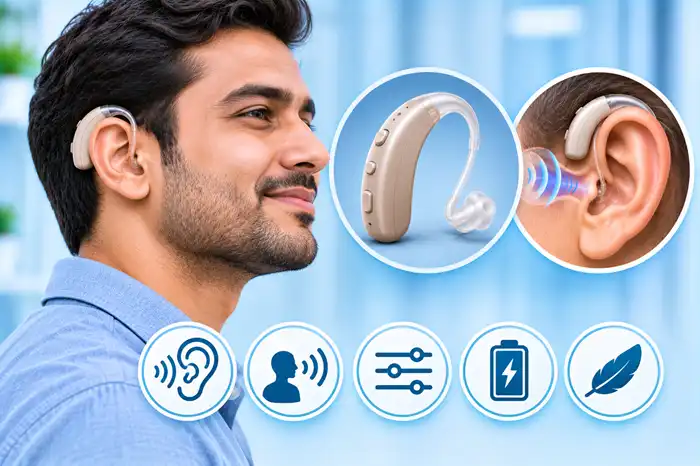
One of the most popular and adaptable hearing aid types is the behind-the-ear (BTE) model for those with mild to severe hearing loss. Conveniently positioned behind the outer ear, BTE hearing aids are fastened to a custom-made ear mold or a thin tube that allows sound to enter the ear canal. Strong amplification, robustness, and versatility for all age groups—including kids and senior citizens—are what set BTE hearing aids apart.
At LIKITA Hospital, services for Behind-The-Ear hearing aids are offered as part of a comprehensive audiological and hearing rehabilitation program under the professional guidance of Dr. Rajneesh Ranjan, along with advanced evaluation, fitting, programming, and rehabilitation procedures conducted by the qualified audiology team of HEARZAP.
How do behind-the-ear (BTE) hearing aids work?
BTE hearing aids are external hearing instruments worn behind the ear. They consist of two basic components:
- A behind-the-ear sound processor
- A tube or wire linked to an ear mould or receiver in the ear canal
The machine captures sound using a microphone, processes it digitally, and produces amplified sound for the ear.
What are the key features of BTE hearing aids?
- Can be used by people with any degree of hearing impairment
- Have a strong amplification capacity
- They are durable and easy to maintain
- They are comfortable to wear
Who needs behind-the-ear hearing aids?
At LIKITA Hospital, BTE hearing aids are advised for:
- Babies and young children who have congenital hearing problems
- Adult patients with moderate to profound hearing impairment
- Older patients with age-related hearing loss
- Patients with fluctuating or progressive hearing impairment
- For patients who need high-power amplification
BTE devices are usually the first type of hearing aid prescribed for babies and toddlers undergoing hearing rehabilitation.
What are the different types of BTE hearing aids?
There are different types of BTE hearing aids based on a patient’s hearing needs. They include:
a) Conventional BTE
- Traditional model with ear molds
- Suitable for people with moderate to severe hearing problems
- High amplification capacity
b) Open fit BTE
- Employing slim tubes with soft domes
- Suitable for use in case of mild to moderate hearing problems
- Natural sound production and less occlusion
c) Power BTE / Super Power BTE
- Fitted for severe to profound hearing loss
- It has a very high amplification capacity.
- Frequent among pediatric hearing aid fittings
d) Receiver-in-Canal (RIC) type
- The ear canal is where the receiver is placed.
- Small and less visible
- Clarity and comfort of sound
Which hearing tests are required before BTE hearing aid fitting?
Appropriate selection of BTE hearing aids is only possible after thorough audiological testing. The audiological test process at LIKITA Hospital involves:
a) Pure Tone Audiometry (PTA)
- Type and degree of hearing loss
b) Speech Audiometry
- Speech understanding capability
c) Tympanometry
- Functioning of the middle ear
d) Otoacoustic Emissions (OAE)
- Functioning of the Cochlea
e) Auditory Brainstem Response (ABR)
- Appropriate for babies and non-cooperative subjects
The interpretation of all the above test results is done under the guidance of Dr. Rajneesh Ranjan, together with audiologists from HEARZAP.
How are ear moulds made and fitted for BTE hearing aids?
BTE hearing aids usually need an individual ear mould.
What is the step-by-step ear mould fitting procedure?
- Ear canal examination by an ENT specialist
- Taking a soft silicone ear mould
- Preparation of a custom ear mould
- Attaching and fitting of the device
- Checking for comfort and sound leakage
Precision Ear Molding at LIKITA Hospital ensures proper fit and accurate sound transmission.
How are BTE hearing aids digitally programmed and adjusted?
BTE hearing aids nowadays are digitally programmed for each patient.
What does the programming process include?
- Adjustment of frequency-specific amplification
- Activation of the noise reduction function
- Set up feedback suppression parameters.
- Optimization of speech enhancement
- Automatic adjustment depending on the environment
An audiologist adjusts the device to the patient’s needs.
What are the features of modern BTE hearing aids?
The features that modern BTE hearing aids have are:
- Directional microphones for better focusing on speech
- Adaptive noise reduction system
- Feedback cancellation
- Bluetooth connectivity (in some models)
- Battery rechargeability
- Automatic sound environment adjustment
- High power amplification for profound hearing loss
What are the benefits of BTE hearing aids?
- For all levels of hearing loss
- Very robust and durable
- Convenient to use and maintain
- Favored by kids and senior citizens
- Effective amplification for profound hearing loss
- Easily adaptable with customized ear molds
- Convenient adjustment capabilities
What are the disadvantages and limitations of BTE hearing aids?
Though very efficient, BTE hearing aids can be associated with certain limitations:
- Somewhat noticeable behind the ear
- Requires cleaning of the ear molds on a regular basis
- Somewhat bulky for some patients at first
- Proper fit is important to prevent feedback sounds.
At LIKITA hospital, all these disadvantages are avoided due to appropriate fit and support.
What does the BTE hearing aid rehabilitation and follow-up process involve?
The successful use of the hearing aids requires an adequate rehabilitation process. At HEARZAP, the following services are offered:
- Auditory training assistance
- Speech comprehension improvement therapy
- Device tuning and maintenance
- Monitoring of hearing recovery
- Counseling services for patients and their relatives
How are BTE hearing aids used in pediatric hearing treatment?
Behind-the-ear hearing aids are particularly useful in pediatric hearing treatment:
- Safe and easily adjustable design to fit growing ears
- Powerful amplification capacity in case of congenital hearing impairment
- Integration into speech therapy programs
- Frequent adjustments due to fast ear growth
- Training for parents and in-home practice sessions
The early fitting will greatly improve outcomes in speech and language development.
What infrastructure and facilities are available for BTE hearing aid fitting?
The LIKITA Hospital has a highly developed audiological infrastructure for BTE hearing aid fitting:
- Soundproofed audiology diagnostic rooms
- Digitized audiometers
- Hearing aid fitting laboratories
- Ear impressions and mould fabrication equipment
- Real-ear measurement and verification systems
- Hearing aid trial and counseling rooms
- ENT examination facilities
Last Updated: November 9, 2026
Why choose LIKITA ENT Hospital for behind-the-ear (BTE) hearing aids in Patna, Bihar, India?
LIKITA ENT Hospital is a trusted ENT Centre for behind-the-ear (BTE) hearing aid evaluation, fitting, and rehabilitation in Patna, Bihar, India, providing specialized hearing support for children, adults, and older individuals experiencing mild to profound hearing loss. Under the professional guidance of Dr. Rajneesh Ranjan and with audiological support from the HEARZAP team, patients receive individualized hearing assessment, device selection, fitting, and programming based on their hearing profile and communication needs. The evaluation process may include Pure Tone Audiometry (PTA), Speech Audiometry, Tympanometry, Otoacoustic Emissions (OAE), and Auditory Brainstem Response (ABR) when indicated. With customized ear mould fitting, digital hearing aid adjustments, sound verification, auditory training, maintenance guidance, and regular follow-up, LIKITA ENT Hospital aims to support comfortable hearing aid use, improved speech understanding, and better everyday communication. Personalized counseling and rehabilitation recommendations also help families support children’s hearing and speech development.
To seek an Expert Consultation for Behind-the-Ear (BTE) Hearing Aids in Patna, Bihar, India: