What is a cochlear implant and how does it help restore hearing?
For those with severe hearing loss who are unable to wear hearing aids, cochlear implants and auditory brainstem implants (ABIs) are among the best options. Cochlear implants and Auditory Brainstem Implants are surgical devices that help individuals hear by stimulating the auditory nerve pathway, making sound and speech perceivable.
Dr. Rajneesh Ranjan, an experienced ENT Surgeon, is the head of the Cochlear Implant & Auditory Rehabilitation program at LIKITA ENT Hospital, along with HEARZAP’s superior Audiological mapping and rehabilitation facilities.
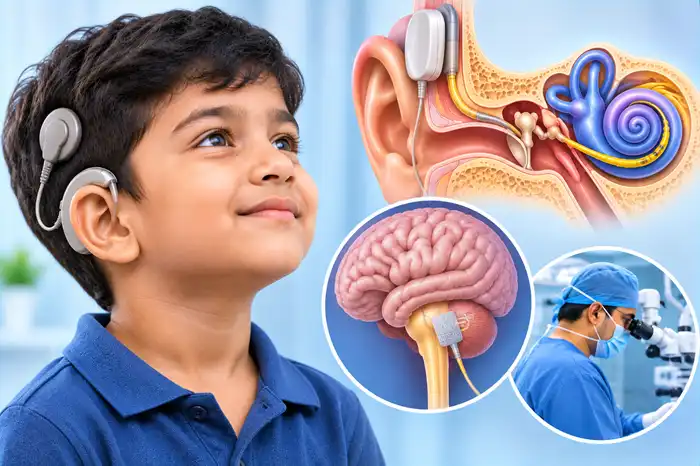
What are the parts of a cochlear implant?
A cochlear implant is a state-of-the-art electronic medical device for those with severe-to-profound sensorineural hearing loss. A cochlear implant stimulates the auditory nerve, whereas a hearing aid amplifies sound.
Parts:
- External processor (worn behind the ear)
- Internal processor (implanted under the skin)
- Electrode array (inserted in the cochlea)
How does a cochlear implant work?
- Translates sounds into electrical impulses.
- Stimulation of auditory nerve fibers directly
- Conveys signals to the brain to interpret sounds
What is an auditory brainstem implant (ABI) and who may need it?
An Auditory Brainstem Implant (ABI) is an innovative hearing device that can help individuals who lack a cochlear nerve or have a severely damaged one, making cochlear implantation impossible.
What is the difference between a cochlear implant and an ABI?
Difference:
- Cochlear implant – stimulates the cochlear nerve.
- ABI – stimulates the cochlear nucleus located in the brainstem
What are the indications for an auditory brainstem implant?
Indications:
- Birth defect of the cochlear nerve
- Neurofibromatosis type 2 (NF2)
- Severe abnormalities of inner ear structures
- Post-radiation auditory nerve damage
Who is eligible for cochlear implant and ABI programs?
Patients may be considered candidates for a cochlear implant or ABI if they have:
- Severe-to-profound sensorineural hearing loss
- Little or no benefit from hearing aids
- Pre- or post-lingual deafness
- Hearing loss since birth in children
- Hearing loss progression
- Hearing impairments associated with the auditory nerve (ABI)
Early identification of hearing impairment leads to better outcomes in speech and language development.
How is cochlear implant and ABI candidacy assessed?
Candidacy assessment at LIKITA ENT Hospital is conducted by ENT specialists, audiologists, and rehabilitation experts.
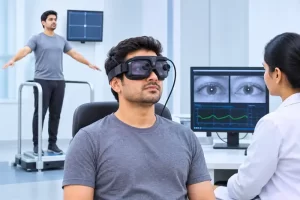
Which tests are included in the evaluation?
Important Tests Include:
- Pure tone audiometry
- Speech recognition test
- Tympanometry and impedance measurement
- Otoacoustic Emissions (OAE)
- Auditory Brainstem Response (ABR)
- High-resolution images (CT/MRI)
- Psychological and speech-language evaluations
This evaluation will be done under the guidance of Dr. Rajneesh Ranjan and the audiology department of HEARZAP.
How are cochlear implant and ABI surgeries performed?
What happens during cochlear implant surgery?
- Surgery under general anesthesia
- Surgical incision behind the ear, post-auricular
- Drilling of the mastoid bone to expose the cochlea
- Cochlear implant with an electrode array.
- Receiver stimulator implanted under the skin
- The incision is closed with minimal scarring.
How is auditory brainstem implant surgery performed?
- More complicated neurosurgeon ENT surgery
- Brainstem area exposed by the posterior fossa approach
- Electrodes are placed in the cochlear nucleus.
- Advanced intraoperative monitoring is required.
Both of the above surgical procedures are performed under controlled conditions at LIKITA ENT Hospital.
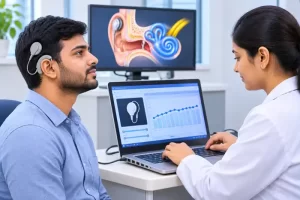
What happens after surgery during implant activation and mapping?
The implanting procedure is just one part of the process.
How is cochlear implant mapping performed?
Mapping Process of Cochlear Implant:
- Activated within 2-4 weeks of surgery
- Levels of electrical stimulation adjusted.
- Several appointments necessary
- Sound recognition is improving gradually.
How is mapping performed for an ABI?
Mapping for ABI:
- A more complicated neural adjustment process
- Necessity of mapping appointments
- Emphasis on sound perception and speech training
Experts in Audiology working at HEARZAP are involved in this stage.
Why are rehabilitation and speech therapy important after implantation?
The results of the operation largely depend on rehabilitation.
What does cochlear implant and ABI rehabilitation involve?
Rehabilitation Involves:
- Speech and language training (children especially)
- Exercises for auditory skills
- Lip-reading assistance
- Family counseling and support
- Ongoing check-ups
Children who underwent an operation at an early age benefit the most from rehabilitation.
What are the advantages of cochlear implants and ABI treatment?
- Great improvement in hearing ability
- Beneficial effect on speech and language skills
- Better social interactions and communication
- Better academic and professional performance
- Better independence and quality of life
- Ability to hear environmental sounds and speech
What are the risks and concerns associated with cochlear implants and ABI?
Just like any surgery, some considerations are:
- Risks of surgery (infection, hemorrhage – rare)
- Malfunction of the device (occasionally happens)
- Lifetime monitoring and adjustment
- Varying success depending upon the period of deafness
- High demands for rehabilitation
Proper patient selection and surgical expertise can mitigate most of these risks.
Why choose LIKITA ENT Hospital for cochlear implant and auditory brainstem implant (ABI) treatment in Patna, Bihar, India?
LIKITA ENT Hospital is a trusted ENT Centre for cochlear implant and auditory brainstem implant (ABI) evaluation and treatment in Patna, Bihar, India, providing specialized hearing care for children and adults with severe-to-profound sensorineural hearing loss who receive little or no benefit from conventional hearing aids. Under the guidance of Dr. Rajneesh Ranjan, patients receive individualized ENT assessment and candidacy evaluation with support from the HEARZAP audiology and rehabilitation team. The evaluation may include Pure Tone Audiometry, Speech Recognition Testing, Tympanometry, Otoacoustic Emissions (OAE), Auditory Brainstem Response (ABR), CT/MRI imaging, and speech-language assessment, depending on clinical needs. The program focuses on coordinated care, including implant surgery when appropriate, post-surgical activation and mapping, auditory rehabilitation, and speech and language therapy. LIKITA ENT Hospital aims to support improved sound awareness, communication skills, and long-term hearing rehabilitation through personalized treatment planning, family counseling, and regular follow-up.
To seek an Expert Consultation for a cochlear implant and an auditory brainstem implant in Patna, Bihar, India