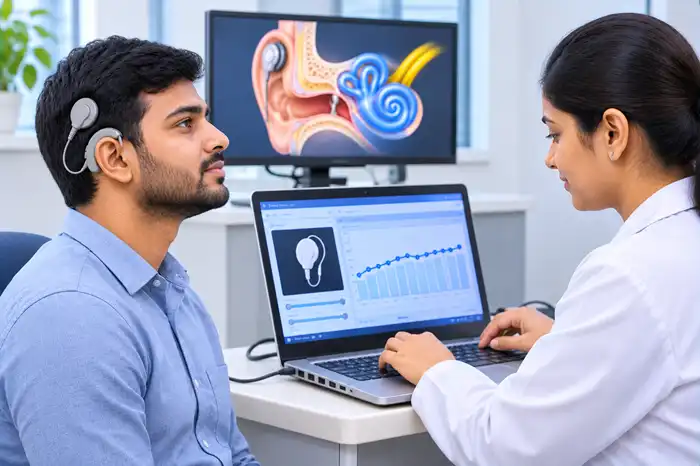
Programming of a cochlear implant device, also known as mapping, is an extremely specialized audiology procedure used to adjust and optimize the function of the cochlear implant system, which is implanted in a patient’s body after surgery. This procedure is crucial to helping the patient achieve the best possible hearing and speech with his or her cochlear implant device.
At LIKITA ENT Hospital, cochlear implant programming services are provided within an auditory rehabilitation program led by Dr. Rajneesh Ranjan (ENT specialist), in collaboration with HEARZAP audiologists who specialize in cochlear implant mapping and auditory rehabilitation.
What is cochlear implant programming and how does it work?
Implant programming is a procedure in which the settings of the implant’s sound processor are adjusted to ensure that the signals sent to the auditory nerve are pleasant, clear, and meaningful.
Whereas hearing aids only amplify sound, cochlear implants send electrical pulses into the auditory nerve. Therefore, proper programming is important because the brain needs to understand the impulses.
Why is mapping important for cochlear implant patients?
Mapping is vital since each patient will experience different electrical impulses from their auditory nerve. Effective mapping guarantees:
- Convenient volume of hearing (no soft or too loud signals)
- Good quality of speech and hearing
- Ability to gradually get used to the new sensations
- Balance of sounds on all frequencies
- Better hearing in a noisy environment
If no mapping sessions are done, the cochlear implant won’t provide its maximum effect.
When is cochlear implant programming carried out?
In LIKITA ENT Hospital, cochlear implant programming is done several times:
When does initial activation take place?
- Usually 2–4 weeks post-surgery
- When the implant is activated for the first time
- The first introduction of sounds to the patient
How often are regular mapping sessions required?
- Temporary programming in the first 3–6 months
- Adaptation of the brain to electrical impulses
Which components are adjusted during cochlear implant programming?
A number of elements are adjusted during mapping processes:
- Thresholds (minimum detectable sounds)
- Comfort levels (maximum allowable stimulation)
- Frequency map (distribution of pitches)
- Adjustment of loudness across electrodes
- Settings for handling environmental noises
- Speech processing methods
The adjustments are done using specialized audiology software.
How is the cochlear implant programming procedure performed?
At LIKITA ENT Hospital, it is done in a controlled medical setting:
What happens during the patient assessment?
- Recap of hearing experience since last appointment
- Evaluation of sound clarity and comfort levels
How is the cochlear implant connected for programming?
- Connection of the external processor to the programming software
- Accessing information from the internal implant
How are the electrodes tested?
- Test each electrode separately.
- Detection of response thresholds
How are mapping settings adjusted?
- Tuning of stimulation levels
- Adjusting frequencies
How are sounds tested after adjustment?
- Responding to voice and sound samples
- Adjustments according to the patient’s perceptions
What happens during finalization?
- Saving a new program to the device
- Adjustments were provided to the patient.
What is the role of audiology and rehabilitation in cochlear implant programming?
Cochlear implant programming is largely dependent on the process of auditory rehabilitation. In HEARZAP, services include:
- Auditory rehabilitation exercises
- Speech perception therapy
- Skills for listening
- Sound discrimination therapy
- Communication rehabilitation
It enables the brain to interpret sounds in electrical impulses.
Why is cochlear implant programming important for children?
Programming is essential for children as their auditory systems continue to develop.
The services include:
- Mapping that is soft and comfortable for the child
- Adjustments regularly done
- Development of speech and language was tracked.
- Training and counseling parents
- Integration into the early intervention program
Early and consistent mapping greatly improves the language results in children.
Which hearing issues can cochlear implant programming help address?
Cochlear implant programming assists in the management of:
- Speech recognition difficulties under noise conditions
- Distortion of sounds or discomfort caused by sounds
- Imbalance of hearing perception
- Inadequate sound awareness
- Adaptation problems for new users
What are the advantages of cochlear implant programming?
- Better speech clarity and understanding
- Adaptation to environmental sounds
- Enhanced ability to communicate
- Comfortable experience during listening
- Temporary improvement in hearing performance
- Development in auditory performance
Why is long-term follow-up important after cochlear implant programming?
The users of cochlear implants need constant monitoring and adjustment:
- Mapping sessions
- Checking of device performance
- Vocal performance evaluation
- Hearing evaluation
- Supervision of the rehabilitation process
- Upgrading of software and its optimization
At LIKITA ENT Hospital, there is a systematic follow-up that guarantees permanent improvement in hearing results.
Why choose LIKITA ENT Hospital for cochlear implant programming in Patna, Bihar, India?
LIKITA ENT Hospital is a trusted ENT Centre for cochlear implant programming and auditory rehabilitation in Patna, Bihar, India, providing specialized mapping services for children and adults who have undergone cochlear implant surgery. Under the guidance of Dr. Rajneesh Ranjan, an ENT specialist, and in collaboration with HEARZAP audiologists, patients receive individualized programming and hearing support based on their listening experience, sound perception, and communication needs. The programming process may include electrode testing, threshold and comfort level adjustments, frequency mapping, sound processor optimization, and regular assessment of hearing responses. For children, care may also include age-appropriate mapping, parental counseling, and coordination with speech and language rehabilitation. With ongoing mapping sessions, auditory training, device performance checks, and long-term follow-up, LIKITA ENT Hospital aims to support comfortable listening, improved sound awareness, and better speech understanding and communication over time.
To seek an Expert Consultation for cochlear implant programming in Patna, Bihar, India: