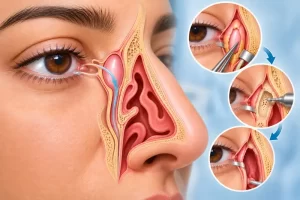
Balloon Sinuplasty is an advanced technique that uses a balloon catheter to open the drainage pathways of patients with chronic sinusitis. It involves opening the nasal drainage pathways and restoring proper sinus ventilation without removing substantial tissue or bone structures; therefore, it is a safer option than sinus surgery.
Normally, sinuses are a group of air-filled cavities around the nose that help drain nasal mucus through small openings into the nasal passages. When these pathways are blocked by factors such as swelling, allergies, inflammation, or infections, mucus can build up in the sinus cavities. This eventually results in symptoms such as facial pain or pressure, nasal obstruction, nasal discharge, headache, chronic respiratory infections, and nasal breathing problems.
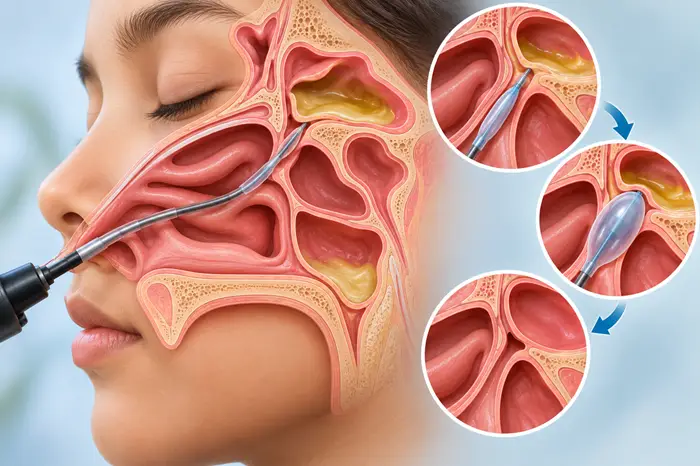
During a Balloon Sinuplasty procedure, the obstructed sinus aperture is filled using a flexible balloon catheter. Low pressure is used to inflate the balloon under endoscopic direction, widening the obstructed sinus drainage pathway and clearing accumulated mucus, thereby facilitating drainage and free nasal breathing. The balloon is then removed from the sinus opening, leaving the sinus passages unobstructed and the natural structure intact. Since this procedure does not involve major excision of tissues and bony structures from the sinus passages, it is less painful, causes less bleeding, has a quicker recovery time, and a faster return to daily routines. Balloon Sinuplasty has become an integral part of the new generation of rhinology and sinus care practices.
Selected individuals who have chronic nasal sinus obstruction and recurrent sinusitis and have not achieved satisfactory relief from conventional medical management might be advised to undergo Balloon Sinuplasty.
Indications are very common:
However, for the most ideal treatment choice, a history of extensive nasal polyposis or sinus destruction is not required.
The blockage of the sinus drainage passages can occur due to several factors that may cause narrowed and obstructed nasal sinuses.
Common causes are:
The resulting sinus blockage leads to mucus buildup and eventual infection.
People who require balloon sinuplasty are generally victims of chronic sinus-related symptoms.
Common symptoms are:
Patients who experience these symptoms for weeks together may be diagnosed with Chronic Sinus Disease. In such patients, if medical management hasn’t yielded results, the doctor might recommend Balloon Sinuplasty.
Before performing balloon sinuplasty, a thorough diagnostic evaluation should be performed.
Diagnosis Includes:
All the above diagnostic procedures help determine whether Balloon Sinuplasty is suitable for the patient and detect nasal blockage.
The Balloon Sinuplasty procedure is typically performed using local anesthesia, and some may require general anesthesia. This procedure involves no major incisional surgery and minimal to moderate pain. It is also sometimes combined with other sinus surgeries.
The balloon will be deflated and taken out, but the opening of the sinus passage will remain open.
All stages are monitored via endoscopic instruments that display a high-definition view on the operating room monitor, helping ensure the safe placement of the balloon catheter without injury to neighboring anatomical structures such as the orbits and brain.
Balloon sinuplasty can also be performed with the septoplasty procedure, which is done to correct nasal septum deviation. These may also be supplemented with Functional Endoscopic Sinus Surgery, nasal polypectomy, and turbinate reduction if needed.
Combining Balloon Sinuplasty with other nasal surgeries, such as septoplasty, turbinate reduction, and FESS, can provide additional benefits and significantly improve nasal breathing.
The recovery process after Balloon Sinuplasty is quite smooth, less painful, and significantly faster than that of traditional sinus surgeries, as only the affected tissues are treated in a minimally invasive manner.
The time to full recovery can vary from patient to patient; most return to their routine life within 2-4 days.
Many patients have reported relief of symptoms for 1-5 years or more, thereby delaying the need for further sinus surgery.
Balloon sinuplasty, although an extremely safe surgical procedure with negligible morbidities and mortalities, is never without its risks, requiring patients to be counseled appropriately about these, but very rarely, complications like the following may be encountered.
Very rare: Injury to orbital structures, cerebral structures, and the brain.
However, it is important to note that careful patient selection and proper postoperative care have reduced the rate of such complications to levels below those of standard surgery.
Even after successfully undergoing Balloon Sinuplasty, a few recommendations are still necessary to maintain long-term relief.
Important Care Tips Include:
LIKITA Hospital is a trusted ENT Centre for Balloon Sinuplasty in Patna, Bihar, India, providing specialized evaluation and treatment for chronic sinusitis, recurrent sinus infections, nasal blockage, and sinus drainage problems. Our experienced ENT specialists use advanced nasal endoscopy, modern diagnostic imaging, and minimally invasive sinus treatment techniques to provide individualized care. With detailed preoperative evaluation, precise endoscopic procedures, appropriate postoperative care, and regular follow-up, LIKITA Hospital focuses on effective sinus treatment, improved nasal breathing, faster recovery, and long-term sinus health.