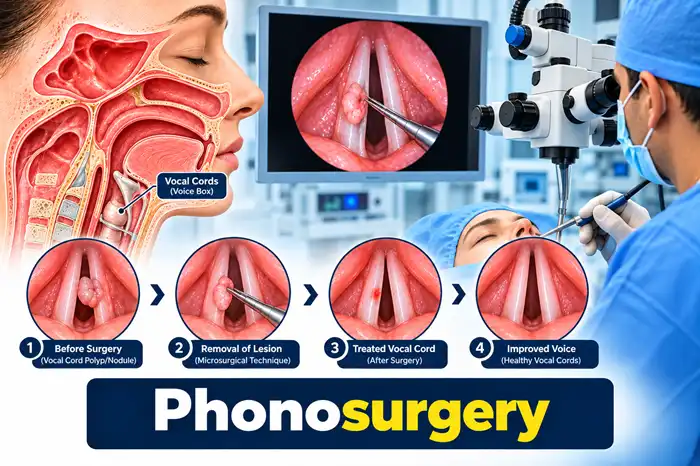
Phonosurgery is a unique specialty within laryngeal surgery that restores, improves, and protects voice function by addressing physical or functional problems of the vocal cords or larynx. It is used to help people with voice disorders that are persistently impacting their speech, communication, profession, and life.
Human voice emanates from vibrations of the vocal cords within the larynx caused by the passage of air from the lungs over the vocal cords. With vocal cord disorders such as nodules, polyps, cysts, paralysis, scarring, tumors, and aging of the cords, the voice is not vibrated properly, resulting in a range of problems, including hoarseness or breathiness and vocal fatigue. Phonosurgery solves this problem.
Today’s phonosurgery techniques use highly precise, delicate endoscopic and microscopic equipment. Procedures are most often performed through the mouth, so patients remain completely free of scars and external wounds. Depending on the underlying pathology, the procedure can include removing abnormal growths, strengthening weak vocal cords, repairing scarred vocal tissues, and reconstruction.
The benefits of phonosurgery are crucial not only for professionals who rely on their voices, such as performers, singers, speakers, and teachers, but also for people from all walks of life whose communication is disrupted and whose life satisfaction consequently decreases.
It is produced by the vibration of the vocal cords, driven by airflow from the lungs.
Structures Involved in Voice Production:
• Vocal Cords
• Voice Box
• Lungs & Airways
• Mouth & Tongue
A good voice is dependent on how the vocal cords move and vibrate.
Those with voice disorders unresponsive to medication or voice therapy may need phonosurgery.
Indications include:
• Vocal cord nodules
• Vocal cord polyps
• Vocal cord cysts
• Vocal cord paralysis
• Persistent hoarseness
• Scarring of the vocal cords
• Reinke’s edema
• Benign vocal cord tumors
• Vocal cord weakening with age.
• Voice problems for professionals
Early surgical intervention can preserve long-term voice quality.
Many different conditions can contribute to vocal cord or voice damage.
Common causes include:
• Overuse or strain of the voice
• Exposure to tobacco smoke
• Gastroesophageal reflux disease (GERD or LPR)
• Vocal cord injury or trauma
• *Viral infections
• Neurological disorders
• Paralysis of the vocal cords
• Tumors, benign and malignant
• Weakening of the vocal cords with age
Voice users, especially those who perform, may develop vocal cord conditions from repeated strain.
Typical symptoms prompting an evaluation for phonosurgery include.
Common Symptoms:
• Hoarseness
• Breathy or weak voice
• Fatigue in the voice
• Difficulty projecting the voice
• Habitual throat clearing
• Breaks or instability in the voice
• Restricted vocal range
• Pain in the throat while speaking
• Unclear speech
Persistent voice changes, even those lasting over 2 weeks, warrant referral to an ENT for evaluation.
A thorough evaluation is necessary before selecting the appropriate phonosurgery procedure.
The typical diagnostic workup:
• Detailed ENT examination
• Laryngoscopy
• Video laryngoscopy
• Stroboscopy (measures vocal cord vibratory patterns)
• Speech and voice assessment
• Computer voice analysis
• Diagnostic imaging as needed
• Biopsy of suspicious vocal cord lesions
The patient’s specific vocal problem is then precisely diagnosed and quantified through the workup.
Typically performed under general anesthesia utilizing precise microscopes and endoscopic technologies:
Procedure Overview:
• Microscopic viewing of the vocal cords
• Correcting structural or functional problems of the vocal cords
• Removal of growths or scarring where necessary
• Augmenting the voice cords with implants in select cases
• Preserving healthy vocal cord tissue to maintain vibratory function
This type of surgery avoids an external incision in the neck by being performed through the mouth, making it minimally invasive.
Precision surgical instruments and modern high-definition endoscopic imagery make phonosurgery both safe and highly accurate.
Many surgical options are available, which include:
• Lesion excision via microlaryngoscopy
• Increasing the vocal cords with an injection
• Thyroplasty via medialization
• Healing of scars
• Laser treatment of vocal cord defects
• Procedures for the reconstruction of vocal cords
The appropriate procedure for each individual is determined by their specific voice problem and vocal needs.
A recovery period of several weeks can be expected.
Recommended post-operative steps:
• Periods of voice rest
• Maintaining optimal hydration and steam inhalation
• Complete cessation of smoking and avoiding irritants
• Regularly taking any prescribed medication.
• Following recommended voice therapy protocols
• Follow-up laryngoscopic exams
Temporary hoarseness and a sore throat sensation can occur during the healing phase.
Phonosurgery can dramatically improve vocal quality and communication abilities.
Advantages of the method:
• Improved speech clarity and strength
• Higher endurance of the voice
• Reduced risk of becoming hoarse
• Optimized vocal cord functioning
• Better verbal communication ability
• A vocally healthy workplace environment
• Boosted self-confidence and self-respect
Most patients report significant improvement in their voices following the surgery.
While extremely rare, potential complications of phonosurgery exist.
Possible risks:
• Temporary voice change
• Bleeding
• Infection
• *Scarring of the vocal cord
• Persistent hoarseness
• Airway swelling (very rare)
Additional therapy or revision surgery may be required in some cases.
Correct surgical technique and proper postoperative voice rehabilitation can help prevent these problems.
Ongoing care for your voice after your surgery is very important.
Helpful suggestions:
• Minimize vocal strain
• stay hydrated
• Avoid alcohol and smoking.
• Follow the voice therapy advice.
• Treat acid reflux if applicable.
• Regular visits to your ENT doctor
Good habits maintain a good voice.
LIKITA ENT Hospital is a trusted ENT Centre for Phonosurgery in Patna, Bihar, India, providing specialized evaluation and treatment for vocal cord nodules, polyps, cysts, vocal cord paralysis, scarring, Reinke’s edema, benign vocal cord tumors, persistent hoarseness, and other voice disorders. Our experienced ENT surgeons use advanced laryngoscopy, video laryngoscopy, stroboscopy, operating microscopes, and high-definition endoscopic techniques to accurately diagnose and precisely treat vocal cord and laryngeal problems while preserving healthy vocal tissue and voice function. With comprehensive voice assessment, individualized surgical planning, specialized phonosurgical techniques, voice therapy, and dedicated postoperative follow-up, LIKITA ENT Hospital focuses on improving voice quality, restoring vocal function, supporting professional voice users, promoting smooth recovery, and achieving better long-term communication and quality of life.