What is Speech Delay in Children?
Speech delay is characterized by a child’s inability to acquire speech and language skills at the expected rate and is evident when compared with peers of the same age. The speech delay might indicate a hearing deficit, a neurological or developmental disorder, or a communication disorder. Even though development varies among children, a significant delay in speech may indicate a communication or developmental problem. There is a strong connection between speech and one’s hearing capacity as well as brain development. Although speech delay cannot be completely avoided, timely diagnosis and management play a very important role in realizing one’s full communication potential. Speech delay management includes approaches for addressing hearing problems.
What Causes Speech Delay in Children?
Children may experience delayed speech due to a number of factors, including developmental or medical factors.
Possible Causes include:
- Hearing loss or deafness
- Ear infections
- Autism spectrum disorder
- Developmental delay
- Neurological problems
- Coordination problem of the mouth muscles or the tongue
- Intellectual disability
- Early birth
- Lack of language stimulation
- Genetic conditions
There are many other reasons for late language acquisition that can occur at once.
What are the Symptoms of Speech Delay in Children?
The kid’s age and the severity of the communication impairment determine the symptoms.
Possible Symptoms may include:
- Delayed babbling.
- Lack of spontaneous or directed speech by the age when other children do.
- Difficulty formulating sentences.
- Limited vocabulary.
- Poor receptive language skills: may struggle with instructions or questions, may only understand the meaning of a word, and struggle to grasp the concept.
- Unclear articulation of words.
- Behavioral problems such as withdrawal, shyness, aggression, and self-isolation.
- Lack of responsiveness to speech or sound stimuli.
- Parental concern-often one of the first signs-children are significantly less talkative than their peers, and parents are unable to express themselves in the manner that their contemporaries do.
Types of Speech Delay in Children
There are several different types of speech delay, each involving a different aspect of communication.
- Expressive Language Delay: Here, the child has difficulty speaking and formulating words and sentences; however, he/she can understand and comprehend spoken words.
- Receptive Language Delay: Here, the child experiences difficulty understanding spoken words, their meanings, and concepts; however, he/she can verbalize the same words.
- Mixed Receptive-Expressive Delay: In this, the child has difficulty both understanding spoken words and expressing his/her thoughts in words.
- Speech Sound Disorders: Here, the child might have difficulty pronouncing certain words in a manner that their peers do; he/she may substitute words, omit certain sounds from a word, and have difficulty articulating them distinctly.
How Speech Delay is Diagnosed in Children?
Early and accurate diagnosis of speech delay is paramount in implementing an effective therapy program. Tests conducted would include:
- A full developmental and medical history of the child
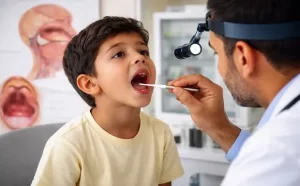
- Ear, nose, and throat examination and a detailed hearing assessment, which involves both behavioral and audiological assessment, along with OAE and BERA testing
- Speech and language therapy assessment
- An oral-motor examination
- A behavioral and developmental evaluation of the child, and in cases where the above tests might be normal, a neurological assessment
It is essential that any underlying hearing deficit in the child is identified.
How Speech Delay Treated in children?
Treatment for speech delay would largely depend on the cause and severity.
- Speech & Language Therapy: The primary treatment for speech delay consists of speech and language therapy to help improve the child’s communication skills and effectiveness of expression. The therapy would include: building language and speech development; encouraging spontaneous speech; vocabulary-building sessions; and improving word clarity and intelligibility through targeted interventions, home-based parent training, and support networks to facilitate speech stimulation in the home environment.
- Hearing Rehabilitation: Hearing loss identified in the child might require hearing aids, a cochlear implant assessment if the hearing loss is severe, and/or auditory-verbal therapy.
- Medical and ENT Management: Treatment may also be required for conditions like chronic ear infections, glue ear, and enlarged adenoids.
- Developmental Support: In cases where developmental delay is the reason, additional supports may be necessary alongside ENT and audiological management; these could include educational and developmental interventions.
What are the complications of Speech delay in children?
- Language delay is associated with various issues that impact both a child’s communication and development.
- Learning difficulties.
- Poor academic performance.
- Social interaction issues.
- Low self-confidence.
- •Behavioral and emotional problems.
- Delayed cognitive development.
How can Speech delay be prevented in children?
Not all children would be able to avoid the risk, but there are methods that would facilitate the developmental aspects and ensure healthy language progression:
- Regular childhood hearing checkups.
- Treatment of chronic ear infections on time.
- Increased interaction with the child.
- Reading sessions with the child.
- Limiting media exposure and excessive screen time.
- Getting timely medical attention from a physician for any concerns related to the child’s development.
Living With the Speech Delay
The speech-delayed child’s condition improves greatly with timely and intensive speech therapy and the full support of parents and loved ones, helping boost self-esteem and enabling the successful development of the child’s speech and language. A speech and language delay in a child does not necessarily reflect the child’s true mental capabilities or intelligence. Parents should always endeavor to remain patient and encourage the child to communicate in various ways. With due intervention, a high level of communication can be achieved.
Why choose LIKITA ENT Hospital for Speech Delay Treatment in Children in Patna, Bihar, India?
Likita ENT Hospital offers safe and effective Speech Delay Treatment in Children in Patna, Bihar, India, at an affordable cost. Our team of experienced Pediatric ENT specialists provides accurate ear, hearing, and throat examination and diagnostic assessment to identify hearing-related or ENT conditions that may affect a child’s speech and language development. Treatment is tailored according to the child’s age, hearing ability, speech and language concerns, underlying condition, and individual needs. When required, our Pediatric ENT specialists can manage associated hearing loss, recurrent ear infections, middle-ear fluid, enlarged adenoids or tonsils, or other conditions that may affect hearing and communication and recommend suitable medical, surgical, or hearing-related treatment along with appropriate speech and language support. With advanced ENT diagnostic facilities, experienced specialists, and a child-focused approach, Likita ENT Hospital is committed to providing safe, precise, and comfortable Speech Delay Treatment in Children in Patna, Bihar, India.
Last Updated: September 14, 2026
To seek an Expert Consultation for Speech Delay Treatment in Children in Patna, Bihar, India: