Sleep apnea in children is a sleep-related breathing problem in which a child’s breathing becomes interrupted or reduced for short periods during sleep. These interruptions can happen many times during the night and may disturb the child’s normal sleep.
The most common type in children is obstructive sleep apnea (OSA). It happens when the upper airway becomes narrow or blocked while the child is sleeping. Enlarged tonsils and adenoids are common reasons for this blockage.
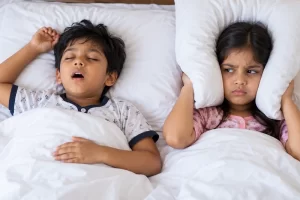
A child with sleep apnea may snore loudly, breathe through the mouth, move around frequently during sleep, or gasp and choke while sleeping. During the day, parents may notice tiredness, irritability, difficulty concentrating or changes in behaviour.
Sleep apnea in children should not be ignored. When a child is not getting good-quality sleep regularly, it can affect daytime activities, learning, behaviour and overall well-being.
Early evaluation by an ENT Specialist can help identify the cause and decide on the right treatment.
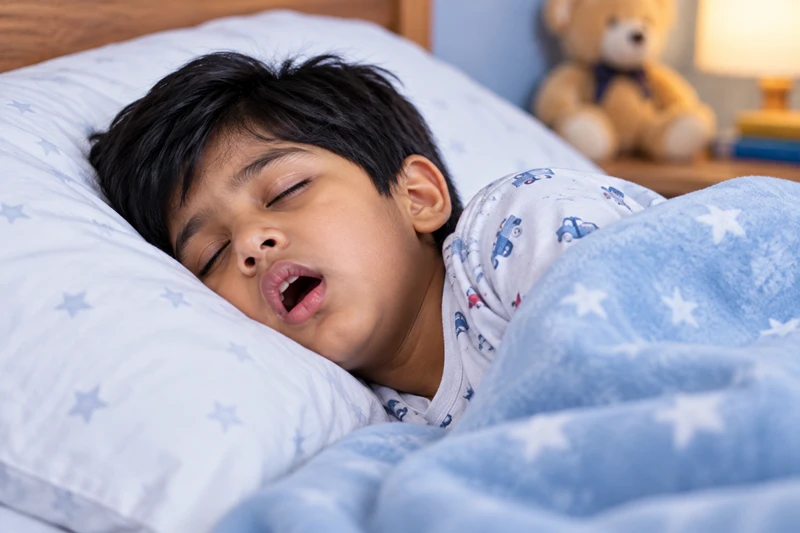
Sleep apnea can develop for different reasons. In children, the airway may become blocked because of enlarged tissues or other problems affecting normal breathing.
Common causes include:
Enlarged tonsils and adenoids are among the most common causes of obstructive sleep apnea in children. When these tissues are large, they can reduce the space through which air passes during sleep.
The symptoms of sleep apnea may be noticed while the child is sleeping as well as during the daytime.
Parents may notice:
A child may not be aware that their breathing is being interrupted. This is why parents often notice the signs first.
Poor-quality sleep can affect how a child feels and behaves during the day.
Some children may have:
These symptoms can also occur for other reasons. However, when they are present along with loud snoring or disturbed breathing during sleep, an evaluation may be helpful.
There are different types of sleep apnea. They do not all have the same cause.
Obstructive sleep apnea is the most common type of sleep apnea in children.
It occurs when the upper airway becomes partly or completely blocked during sleep. The child may continue trying to breathe, but the airflow is reduced or temporarily stopped.
Enlarged tonsils and adenoids are a common cause. Nasal blockage, allergies, increased body weight and certain structural conditions can also contribute.
Central sleep apnea is less common in children.
In this condition, the brain does not send the usual signals to the muscles that control breathing during sleep. Because the cause is different from obstructive sleep apnea, the evaluation and treatment may also be different.
Children with suspected central sleep apnea need proper medical assessment to identify the underlying reason.
The diagnosis starts with a detailed discussion about the child’s sleep and breathing habits.
The doctor may ask parents about:
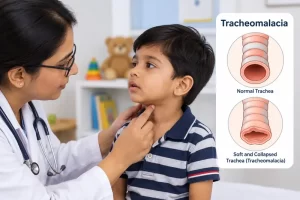
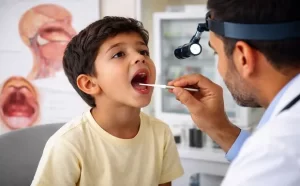
The ENT Specialist will usually examine the nose, mouth and throat. The size of the tonsils and adenoids may also be assessed.
Depending on the symptoms, additional tests may be advised.
Nasal endoscopy may be used when the doctor needs a closer look at the nasal passage and upper airway. It can help assess nasal blockage and the area around the adenoids.
A polysomnography, commonly called a sleep study, can be used to assess sleep-related breathing problems.
During a sleep study, different body functions are monitored while the child sleeps. These may include breathing, oxygen levels, heart rate and brain activity.
The test can help determine whether sleep apnea is present and provide information about its severity.
Not every child with snoring or suspected sleep apnea will need the same tests. The doctor will decide based on the child’s symptoms and examination.
Treatment depends on the cause and severity of sleep apnea.
The main aim is to improve the child’s breathing during sleep and help them get better-quality rest.
If allergies or nasal inflammation are contributing to the problem, the doctor may recommend suitable medicines or nasal treatment.
Treating nasal blockage may improve breathing through the nose, although it may not be enough when enlarged tonsils or adenoids are causing significant airway obstruction.
For children who are overweight, maintaining a healthy weight may help improve sleep-related breathing problems.
Any weight management plan should be suitable for the child’s age, growth and overall health.
Some children may be advised to use positive airway pressure treatment, such as CPAP.
This may be considered when surgery is not suitable, when sleep apnea continues after treatment, or when another medical condition is contributing to the problem.
The treatment should be prescribed and monitored by the appropriate medical team.
When enlarged tonsils and adenoids are causing significant airway blockage, surgery may be recommended.
Common procedures include:
An adenoidectomy is a procedure to remove enlarged adenoid tissue. It may be recommended when the adenoids are blocking the airway and contributing to breathing problems during sleep.
A tonsillectomy involves removing the tonsils when they are enlarged and contributing to airway obstruction.
In some children, both the tonsils and adenoids are enlarged. Removing both may help create more space in the upper airway and improve breathing during sleep.
Surgery is not required for every child with sleep apnea. The decision depends on the child’s symptoms, examination findings and, when needed, sleep-study results.
When sleep apnea continues without treatment, repeated disruption of sleep can affect a child’s health and daily life.
Possible problems include:
The effects can vary from one child to another. Early diagnosis and appropriate treatment can help reduce the risk of these problems.
Yes. Children who are not sleeping well may find it harder to concentrate and stay attentive during the day.
Some children may become irritable or have mood changes. Others may appear more active or restless rather than sleepy.
Parents may also notice changes in school performance or difficulty completing normal activities.
These signs do not necessarily mean that a child has sleep apnea. But if they occur together with loud snoring, gasping or breathing pauses during sleep, it is worth discussing them with a doctor.
Significant or untreated sleep apnea can affect a child’s overall health and development. Some children with sleep apnea may experience problems with growth.
This does not happen in every child, but it is one reason why persistent sleep-related breathing problems should be properly evaluated.
Parents can support their child by following a few simple steps:
Parents can also tell the doctor exactly what they have noticed at night. If the child has unusual breathing, a short video recorded by the parent may sometimes help the doctor understand the symptoms, although it cannot replace a proper medical evaluation.
Parents should consider an ENT evaluation if a child regularly snores or shows signs of breathing difficulty during sleep.
It is particularly important to seek medical advice if the child:
If a child appears to have severe difficulty breathing or develops bluish lips or skin, urgent medical attention is required.
Many children with sleep apnea improve when the underlying cause is identified and properly treated.
Parents should continue to observe the child’s sleep and breathing pattern and follow the treatment plan recommended by their doctor.
If allergies, nasal blockage or enlarged tonsils and adenoids are contributing to the problem, treating these conditions may improve breathing during sleep.
Regular follow-up may be needed, especially if symptoms continue after treatment.
With appropriate management, many children can sleep more comfortably and may have better daytime energy, concentration and overall quality of life.
Sleep apnea is a condition in which a child’s breathing becomes interrupted or reduced repeatedly while they are sleeping.
Obstructive sleep apnea is the most common type. It happens when the upper airway becomes narrow or blocked during sleep.
Yes. Enlarged tonsils can reduce the space in the throat and contribute to blockage of the airway during sleep.
Yes. Enlarged adenoids can block the area behind the nose and contribute to mouth breathing, snoring and obstructive sleep apnea.
No. Children can snore without having sleep apnea. However, loud regular snoring along with breathing pauses, gasping or choking should be evaluated.
No. Treatment depends on the cause and severity. Some children may need treatment for allergies or nasal blockage, while surgery may be recommended for children with enlarged tonsils and adenoids.
A sleep study, or polysomnography, records different body functions while the child sleeps. It can help doctors identify and assess sleep-related breathing problems.
Yes. Poor-quality sleep may contribute to irritability, attention difficulties, mood changes and hyperactivity in some children.
It can. A child who is not sleeping well may have difficulty concentrating, paying attention or staying focused during school activities.
It depends on the cause. Some children improve after the underlying problem is treated. Others may need continued treatment and follow-up.
An ENT Specialist can evaluate common causes such as enlarged tonsils, enlarged adenoids and nasal blockage. Depending on the child’s condition, a sleep specialist or another medical specialist may also be involved.
Likita ENT Hospital offers safe and effective Sleep Apnea Treatment in Children in Patna, Bihar, India, at an affordable cost. Our team of experienced Pediatric ENT specialists provides accurate nose, throat, and airway examination and diagnostic assessment to identify the possible cause and severity of sleep apnea and evaluate its effect on the child’s breathing and sleep. Treatment is tailored according to the child’s age, severity of symptoms, airway condition, sleep pattern, and individual needs. When required, our Pediatric ENT specialists can manage associated snoring, enlarged adenoids or tonsils, nasal blockage, mouth breathing, restless sleep, daytime tiredness, or other sleep-related breathing problems and recommend suitable medical or surgical treatment, including procedures to improve airway blockage when appropriate. With advanced ENT diagnostic facilities, experienced specialists, and a child-focused approach, Likita ENT Hospital is committed to providing safe, precise, and comfortable Sleep Apnea Treatment in Children in Patna, Bihar, India.