Epley’s maneuver is a non-invasive treatment that works very well for Benign Paroxysmal Positional Vertigo (BPPV), one of the most common causes of vertigo. BPPV occurs when tiny calcium carbonate crystals, called otoconia, move from their normal location in the inner ear into the semicircular canals, which are responsible for balance.
These errant crystals float around in the head, irregularly stimulating the balance center, producing dizziness, vertigo, imbalance, and feelings of sickness. The Epley Maneuver is used to return these misplaced crystals to their normal position in the inner ear by positioning the head and body in a specific sequence.
The maneuver is typically performed by an experienced ENT specialist or vestibular rehabilitation specialist and often leads to swift relief of symptoms associated with positional vertigo. For most people, the maneuver has noticeable effects after just one or two treatments.
The Epley maneuver is regarded as a side-effect-free technique that relieves positional vertigo, thereby helping patients build confidence in balancing.
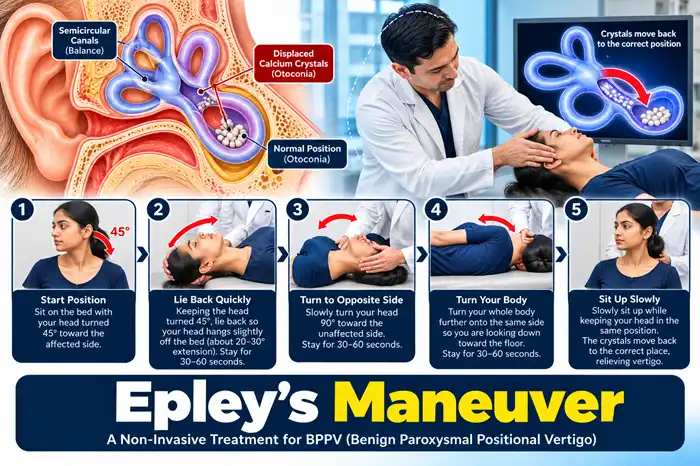
BPPV is a disorder caused by calcium crystals in the inner ear.
Some important characteristics of BPPV are as follows:
• Short duration of feeling dizzy/spinning
• Occurs after changing the position of the head
• Along with it, imbalance and dizziness occur.
• Common with rolling over in bed or looking up
• Usually affects one ear.
BPPV is one of the most common causes of vertigo in adults.
Epley’s maneuver is the treatment of choice for patients with positional vertigo due to BPPV.
Indications of Epley’s maneuver:
• Sudden spinning sensations brought on by the movement of the head
• Vertigo in response to the positional change when lying down and turning over in bed
• Dizziness on looking up or bending forward
• Repeated, recurrent episodes of vertigo
• Balance issues linked to BPPV
• The Dix-Hallpike positional test result is positive.
The maneuver is primarily effective for posterior canal BPPV, which is the most common type.
Several underlying factors can lead to a displacement of inner ear crystals:
• Aging degradation of inner ear structures
• Trauma to the head
• Virus of the inner ear
• Lengthy period in bed
• Other inner ear disorders
• Vestibular issues arising from migraines
• Unknown reason in many cases
Often occurs acutely and unexpectedly.
The symptoms of BPPV generally include brief episodes of spinning sensation that tend to occur suddenly with a change in head position.
Typical symptoms of BPPV:
• Spinning sensation (vertigo)
• Dizziness when the head is moved
• Imbalance
• Nausea
• Problems walking around without staggering
• Vertigo that appears when moving between the lying and standing positions
• A sensation of the body, or the room, spinning despite stillness
• The possibility of falling
Symptoms typically resolve after seconds or minutes, but can reappear.
Accurate assessment before undertaking Epley’s maneuver is paramount.
Evaluation includes:
• An ENT and balance assessment
• A Dix-Hallpike positional test
• Various vestibular function tests
• Observation of eye movements (nystagmus)
• A hearing assessment, where needed
• If required, a neurological assessment is carried out.
These tests help the specialist determine whether you have BPPV and, if so, which ear or canal is affected.
Epley’s maneuver is a series of controlled head and body movements performed under medical supervision.
Procedure breakdown:
• The patient is asked to sit up.
• Their head is gently turned towards the problem ear.
• The body and head are moved sequentially in a set pattern.
• The process takes minutes to perform.
• The crystals in the semicircular canals move into the utricle, which contains gravity-sensing cells in the inner ear that inform the brain of the patient’s head orientation.
The patient’s position is held briefly before being changed.
This is usually done on an outpatient basis, and benefits are often experienced quickly.
Some people may feel slightly giddy for a while following the maneuver.
Advice post Epley’s Maneuver:
• Sudden head movements should be avoided for a brief period.
• If required, you will be instructed to sleep on a pillow in a slightly elevated position.
• You will be guided on vestibular rehabilitation exercises.
• Follow-up appointments are required if symptoms persist.
• Repeated maneuvers may be carried out if symptoms haven’t improved.
For most people, activities will soon return to normal.
This technique is easy to perform for positional vertigo.
Key advantages of Epley’s technique include:
• Helps stop the spinning feeling.
• Improves balance and coordination.
• Helps decrease the frequency of vertigo.
• Provides a feeling of assurance when moving around.
• Helps prevent motion sickness.
• This is not a painful process that requires the use of medications or surgery.
• Patients make a speedy recovery and return to their regular activities.
High success rates have been reported.
Epley’s maneuver is generally extremely safe, though temporary side effects do occur from time to time.
Temporary adverse effects may include:
• Mild dizziness at the time of the treatment
• Transient nausea
• Temporary imbalance
• Vertigo recurring (rare)
Side effects resolve quickly.
Further vestibular rehabilitation therapy is required in some cases of longer-term balance problems.
Simple long-term strategies:
• During acute vertigo, sudden, high-risk movements are to be avoided.
• You will be advised to maintain good health by staying well hydrated.
• Prompt action will be needed if the problem recurs.
• Vestibular rehabilitation exercises will be recommended.
• ENT follow-up appointments will be provided.
Proper ongoing care is needed to reduce recurring bouts of dizziness and improve your long-term balance.
LIKITA ENT Hospital is a trusted ENT Centre for Epley’s Maneuver in Patna, Bihar, India, providing specialized evaluation and treatment for Benign Paroxysmal Positional Vertigo (BPPV), positional dizziness, recurrent vertigo, imbalance, and related vestibular disorders. Our experienced ENT specialists use detailed ear and balance assessments, Dix-Hallpike positional testing, vestibular evaluation, and appropriate repositioning techniques to identify the affected ear and canal and perform the Epley maneuver accurately. With comprehensive diagnosis, individualized treatment planning, vestibular rehabilitation when required, and dedicated follow-up care, LIKITA ENT Hospital focuses on relieving vertigo symptoms, improving balance and confidence during movement, supporting a quick return to daily activities, and reducing the impact of recurrent positional vertigo on quality of life.