Vestibular nerve section is a highly specialized neuro-otologic surgical procedure performed to treat severe, disabling vertigo that does not respond to medications, vestibular rehabilitation, dietary modifications, or other conservative treatments. The surgery involves selectively cutting the vestibular portion of the vestibulocochlear nerve, which carries balance signals from the inner ear to the brain, while preserving the hearing portion whenever possible.
The vestibular system, located in the internal auditory meatus, plays an important role in maintaining balance and spatial perception, as well as in coordinating ocular movements. At times, when vertigo or imbalance occurs due to an inability to control vestibular dysfunction in conditions such as advanced Ménière’s disease, incorrect signals from the diseased ear can cause various symptoms.
Cutting of the vestibular nerve disrupts this improper transmission of balance information to the brain. This surgery is mostly considered after vertigo patients experience debilitating symptoms that greatly impair their quality of life after non-surgical treatment has been extensively tried.
This type of surgery is considered one of the most successful hearing-preservation procedures performed in carefully selected cases of severe vertigo. Advances in modern neuro-otological surgical procedures enable precise dissection and cutting of the vestibular nerve without harming adjacent tissues.
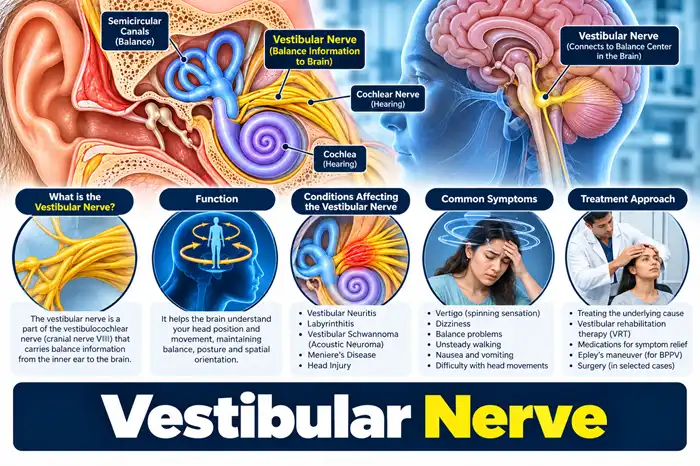
Signals for balance are sent from the inner ear to the brain via the vestibular nerve, a branch of the eighth cranial nerve.
Functions Include the Following:
• Sustaining bodily balance
• Perception of the head movement and positioning
• Body and eye coordination
• Sustained posture and ambulation
Any dysfunction of the vestibular nerves results in severe vertigo and other balance-related disorders.
Indications for vestibular nerve section involve appropriately chosen patients with severe, debilitating vertigo.
Some of the Indications Are:
The procedure is usually considered only after other treatment options have failed.
Patients who require surgical excision of the vestibular nerves usually suffer from severe symptoms associated with their balance.
Some of the Typical Symptoms Are:
• Vertigo spells
• Spinning sensations
• Nausea and vomiting
• Imbalance and unsteadiness
• Difficulty walking
• Tinnitus
• Ear fullness or pressure
• Fluctuating hearing changes
Symptoms may become disabling and interfere significantly with work and daily life.
Detailed neuro-otologic evaluation is essential before surgery.
Diagnostic Evaluation Includes:
• Comprehensive ENT and neuro-otology examination
• Pure Tone Audiometry (PTA)
• Speech audiometry
• Vestibular function tests
• Video Nystagmography (VNG)
• Postural balance testing
• Brain and Internal Auditory Canal MRI scanning
• Hearing preservation test
These studies aid in confirming the diagnosis and assessing surgical viability.
Microscopic neurosurgery and otologic procedures are typically used to accomplish the surgery under general anesthesia.
Surgical Procedure Overview
The surgery may be performed using retrosigmoid, middle cranial fossa, or translabyrinthine approaches, depending on the patient’s condition.
Advanced microscopic equipment and nerve monitoring systems improve surgical precision and safety.
Recovery from vestibular nerve excision happens gradually over several weeks.
What Postoperative Care Involves:
While the brain adjusts to the new inputs of varying vestibular stimuli, some temporary loss of balance is to be expected. frequently observed.
It is an effective method for managing vertigo.
Common Advantages:
Many patients experience substantial improvement in daily functioning after rehabilitation.
Vestibular nerve section is a major neuro-otologic surgery and may occasionally involve complications.
Complications That Can Occur:
With appropriate surgical and rehab intervention, risks can be minimized.
Balance rehabilitation is an important part of recovery after surgery.
Important Long-Term Care Tips Include:
The brain adapts to changes in the vestibular system, thereby improving balance regulation.
LIKITA ENT Hospital is a trusted ENT Centre for Vestibular Nerve Section in Patna, Bihar, India, providing specialized evaluation and surgical treatment for severe and disabling vertigo, Ménière’s disease, refractory vestibular disorders, recurrent vertigo attacks, and balance problems that do not respond adequately to conservative treatments. Our experienced ENT and neuro-otology specialists use comprehensive hearing and vestibular assessment, advanced imaging, microscopic surgical techniques, and appropriate nerve monitoring to selectively address the vestibular nerve while focusing on preservation of the cochlear nerve and hearing function whenever possible. With detailed diagnosis, individualized surgical planning, specialized neuro-otologic care, vestibular rehabilitation, and dedicated postoperative follow-up, LIKITA ENT Hospital focuses on reducing debilitating vertigo, improving balance, supporting hearing preservation, promoting safe recovery, and improving long-term quality of life.