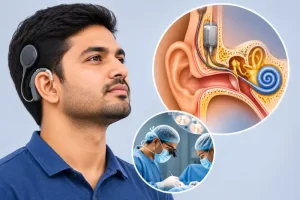
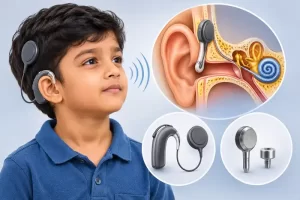
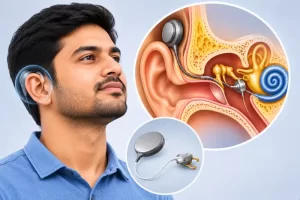
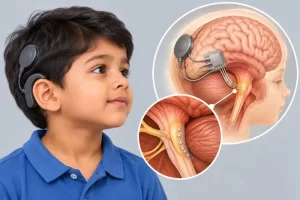
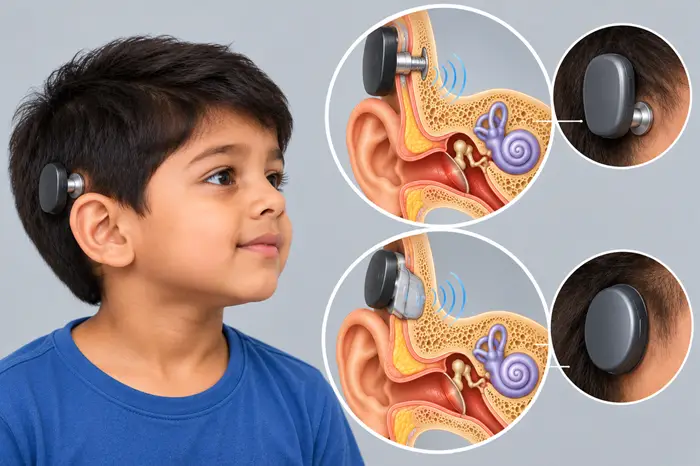
Bone-Anchored Hearing Devices, comprising BAHA (Bone Anchored Hearing Aid) and Bonebridge, are sophisticated devices for those who don’t get enough progress with conventional hearing aids. These devices transfer vibrations from sound waves directly to the inner ear via the skull’s bones, avoiding the center and outer ears. This makes them suitable for people with single-sided mixed hearing loss, conductive hearing loss, and deafness.
Unlike normal hearing aids that amplify sound waves through the ear canal, bone conduction hearing devices pass sound waves through the bones of the skull directly into the inner ear. This process enables people to listen to and better comprehend languages. Bone-conduction hearing aids are helpful for people with hearing problems, whether congenital or acquired.
The BAHA requires placing a titanium screw in the skull, whereas Bonebridge is a fully implantable system in which the processor operates externally.
Advanced bone-conduction hearing technology has significantly improved the lives of people with hearing impairments by enabling them to actively engage in communication, learning, and socializing.
Patients with severe hearing impairment who are not suitable for standard hearing aids may need bone-conduction hearing devices.
These Include:
Hearing test results help identify whether bone-anchoring hearing implants are suitable.
BAHA implants rely on bone conduction, which transmits sound vibrations to the inner ear via a titanium attachment implanted in the skull.
Bonebridge is a bone-anchored hearing device placed under the skin that is more aesthetically pleasing than other options.
Bone-conduction hearing devices held with soft bands/headbands can be used while waiting for surgery, especially in younger patients.
Patients who benefit from these implants often have hearing difficulties despite other treatments.
Common symptoms include:
Early speech therapy is vital to nurture speech and language skills in children. We are committed to supporting children and families through this important stage with understanding and care.
It is essential to evaluate a patient prior to the implant.
Assessments prior to Surgery Include:
All these assessments allow ENT specialists to identify the best hearing implant systems.
Implant surgery is relatively safe and usually carried out with local or general anesthesia, depending on the patient’s age and conditions.
BAHA Surgery
Bonebridge Surgery
Modern surgical techniques can enhance patient experience, increase safety, and improve cosmetic results.
After surgery, the patient can be provided with an external sound processor programmed to meet their hearing needs.
Rehabilitation Consists of the Following Activities:
Long-term aftercare and follow-up help maximize hearing and implant functionality.
Using bone-anchored devices can offer additional benefits for certain patients.
Common Advantages Include the Following:
These implants usually result in great improvement in communication and perception.
This type of surgery is usually quite safe, but complications can still happen.
Possible Complications Include the Following:
Most people cope well with bone-conducted hearing implants, provided they attend regular rehabilitation sessions and take good care of them.
Essential Points To Take Into Consideration:
Good hearing rehabilitation and device maintenance will help you restore your hearing and speech abilities over time.
Last Updated: October 19, 2026
LIKITA ENT Hospital is a trusted ENT Centre for Bone-Anchored Hearing Devices (BAHA and Bonebridge) in Patna, Bihar, India, providing specialized evaluation and hearing rehabilitation options for patients with conductive hearing loss, mixed hearing loss, single-sided deafness, and congenital ear abnormalities. Our ENT specialists focus on comprehensive hearing assessment, careful evaluation of implant suitability, and individualized treatment planning to identify the most appropriate hearing solution for each patient. With detailed audiological testing, modern diagnostic facilities, surgical planning, device programming, and dedicated postoperative rehabilitation and follow-up care, LIKITA ENT Hospital aims to support improved hearing access, speech understanding, and communication. Each patient’s treatment plan is tailored to their hearing needs, medical condition, and suitability for bone-conduction technology.