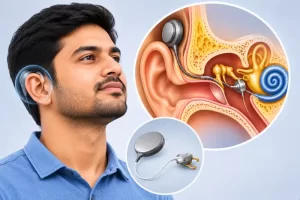
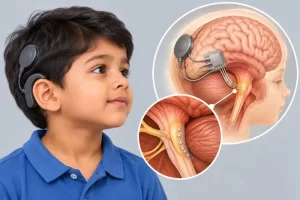
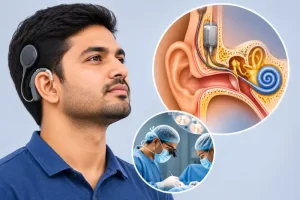
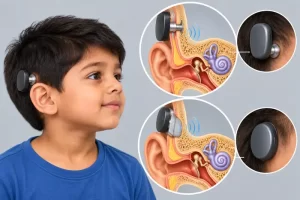
Advanced treatments such as cochlear implants and other hearing implants have significantly changed the management of severe hearing loss in India. Such innovative hearing restoration technologies help people with hearing disabilities reconnect with sound, communication, and speech, ultimately improving their quality of life. In contrast to conventional hearing aids, which simply amplify sounds, cochlear implants and hearing implants stimulate the auditory pathways to improve sound perception and comprehension.
Over the past few years, there have been significant developments in hearing implants, implant procedures, rehabilitation programs, and early detection of hearing loss in the country. Currently, various advanced hearing implants for people with diverse hearing losses are available on the market, including cochlear implants, bone-anchored hearing devices, middle ear implants, and auditory brainstem implants.
Diagnosis and early intervention are vital, particularly in children, where good hearing is crucial to speech and language development. The same is true of adult cases with progressive hearing loss.
Today’s audiology and ENT hospitals in India provide an interdisciplinary approach to hearing rehabilitation programs, involving ENT specialists, audiologists, speech-language pathologists, auditory-verbal therapists, and rehabilitation professionals before and after implant surgeries.
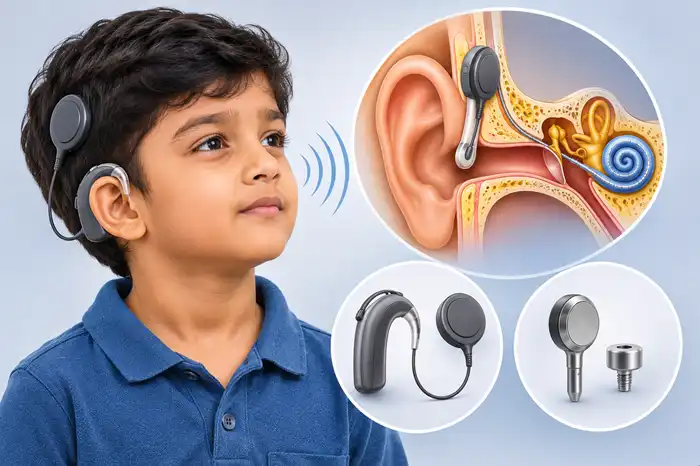
Hearing implants are highly advanced medical devices that help restore hearing in people who are not suitable candidates for hearing aids.
Hearing implant systems include:
The advanced implants are suitable for people with significant hearing loss and certain ear disorders.
Some of These Individuals Are:
Adequate hearing and physical examinations are critical before any surgical intervention.
Many individuals who require hearing implants experience communication difficulties.
The Major Symptoms Associated With These People Are:
Prompt diagnosis considerably improves the chances of successful rehabilitation.
Pre-Surgical Evaluation Consists Of:
They help determine which implant system best suits the patient.
This procedure involves implantation surgery that takes place under general anesthesia through highly advanced microscopic and minimally invasive surgery.
Patients generally recover well from surgery with proper rehabilitation and care.
Hearing implant surgery is just a first step towards rehabilitation; long-term auditory and speech rehabilitation is equally essential.
Rehabilitation Program Consists Of:
Children need ongoing therapy to develop speech and language skills.
Hearing implants nowadays offer many advantages to their users.
Some of the Common Advantages Are As Follows:
The results vary depending on patient age, duration of hearing loss, rehabilitation involvement, and general health.
Hearing implant surgery is usually very safe, but some risks can occur from time to time.
Some Possible Complications May Be:
Proper rehabilitation increases the chances of successful implantation surgery.
Early hearing rehabilitation is crucial for the development of speech and language skills in children with congenital deafness.
Early Hearing Rehabilitation Will Help:
LIKITA ENT Hospital is a trusted ENT Centre for cochlear implants and hearing implant evaluation in Patna, Bihar, India, providing specialized assessment and treatment planning for children and adults with severe hearing loss, limited benefit from conventional hearing aids, and specific hearing-related conditions. Our ENT specialists focus on comprehensive hearing evaluation, careful assessment of implant suitability, and individualized treatment planning to identify appropriate hearing rehabilitation options, including cochlear implants, bone-anchored hearing devices, middle ear implants, and auditory brainstem implants when indicated. With detailed audiological testing, diagnostic investigations, surgical planning, coordination with audiology and speech-language rehabilitation professionals, device activation and mapping, and dedicated postoperative follow-up, LIKITA ENT Hospital aims to support improved sound awareness, speech understanding, communication abilities, and quality of life. Treatment recommendations and expected outcomes are tailored to each patient’s hearing condition, age, medical needs, and rehabilitation progress.