
Tracheomalacia is a condition where the walls of the trachea (also called the windpipe) are weaker than normal. The airway is not rigid, so the trachea collapses to some extent during breathing, particularly on exhalation, when crying, coughing, feeding, or lying down. Difficulty breathing can occur due to airway narrowing and may be associated with breathing sounds in infants and children. Tracheomalacia may be present at birth (congenital tracheomalacia) or may develop as a result of infection, prolonged ventilation, injury to the airway, or compression from a surrounding structure. It can range from mild, in which airway cartilage strengthens or improves with age, to more severe, in which there are recurring respiratory infections, breathing distress, feeding problems, and growth failure. As this condition directly affects the airway, it is important to make an early diagnosis and provide a comprehensive ENT and airway review to promote safe breathing, good health, and development.
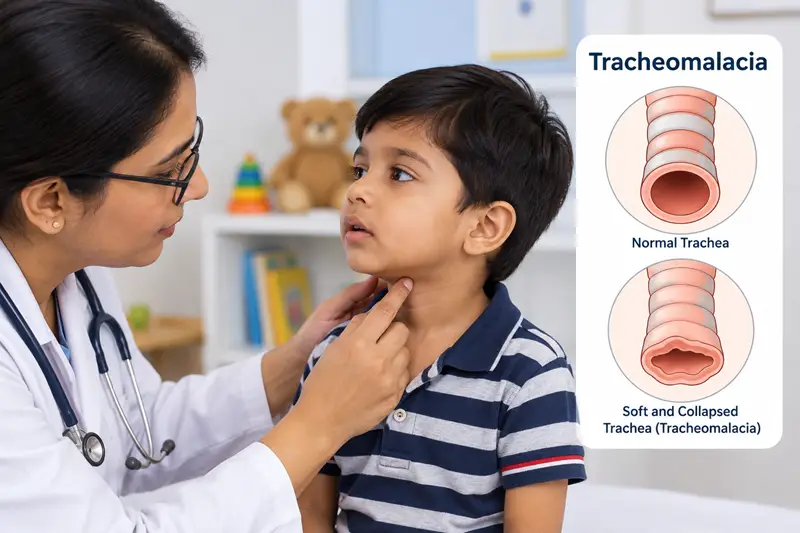
Tracheomalacia is caused by an underdeveloped or weak tracheal cartilage.
Common Causes Include:
Congenital tracheomalacia is generally seen in infants and children.
The degree of airway collapse determines the symptoms.
Common Symptoms Include:
Symptoms tend to worsen during chest infections or exercise.
Tracheomalacia can be classified by its cause and location in the airway.
Accurate assessment of the extent of the airway collapse and the degree of breathing difficulty is required.
Diagnosis Is Made Using:
ENT specialists perform these procedures to provide the appropriate airway evaluation and care.
The treatment of tracheomalacia is tailored to the individual based on age, symptom severity, and the degree of airway collapse.
The child is monitored when the disease is in its milder forms, and the airway may improve on its own as growth progresses and the cartilage gains strength.
Treatment of respiratory infection, control of acid reflux, breathing support, oxygen administration, airway clearance therapy, etc.
Modified feeds may be recommended in infants, and close monitoring of breathing and oxygen levels is required. Preventing respiratory infection.
Surgery is usually resorted to in those who have serious problems with breathing.
The surgeries that can be performed include:
If tracheomalacia is not properly treated, breathing may be affected and so may the child’s development.
Complications that can be expected:
Early diagnosis helps prevent these complications.
Congenital tracheomalacia cannot really be prevented, but early detection is crucial.
Important Measures Include:
Good airway management helps prevent serious complications.
In most children, symptoms of tracheomalacia improve as they get older.
Key Tips for Parents
If well managed, the child will breathe normally and flourish.
Likita ENT Hospital offers safe and effective Tracheomalacia Treatment in Children in Patna, Bihar, India, at an affordable cost. Our team of experienced Pediatric ENT specialists provides accurate airway examination and diagnostic assessment to identify weakening of the tracheal walls and evaluate its effect on the child’s breathing. Treatment is tailored according to the severity of airway collapse, age of the child, symptoms, underlying cause, and individual needs. When required, our Pediatric ENT specialists can manage associated noisy breathing, stridor, coughing, recurrent respiratory infections, breathing difficulties, or feeding problems and recommend suitable observation, medical management, respiratory support, or surgical treatment when appropriate. With advanced ENT diagnostic facilities, experienced specialists, and a child-focused approach, Likita ENT Hospital is committed to providing safe, precise, and comfortable Tracheomalacia Treatment in Children in Patna, Bihar, India.