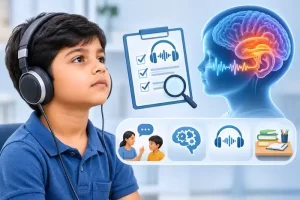
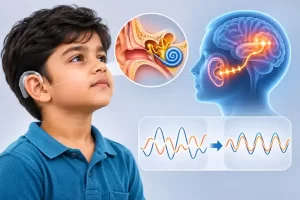
Auditory Verbal Therapy (AVT) is an auditory rehabilitation approach that helps children with hearing loss make maximum use of auditory information through hearing aids and cochlear implants to support listening and verbal communication. Through auditory verbal therapy, children are taught to use auditory skills learned during hearing exercises to develop listening and speech skills and learn spoken language by listening.
Hearing loss can pose serious problems for a child’s development in speech, language, communication, social interaction, and academics, among other areas. For this reason, auditory verbal therapy plays a vital role in helping children incorporate listening into verbal communication as part of developing proper spoken language.
Unlike programs that emphasize lip-reading and sign language, auditory verbal therapy makes the most of listening to help children develop spoken language. The main emphasis in auditory-verbal therapy is teaching children to focus on sound, speech patterns, and environmental sounds to develop auditory skills.
For Auditory Verbal Therapy to have a favorable outcome, it must be started early, after successful fitting of hearing aids or implantation of cochlear implants. This particular treatment approach demands active participation of the child’s parents or other caregivers since communication within the family is crucial.
Current Auditory-Verbal Therapy Programs use customized procedures that consider the child’s age, level of hearing capacity, language development, communication skills, and educational achievements. Consistent monitoring, testing, and auditory stimulation have led to successful Auditory-Verbal Therapy sessions.
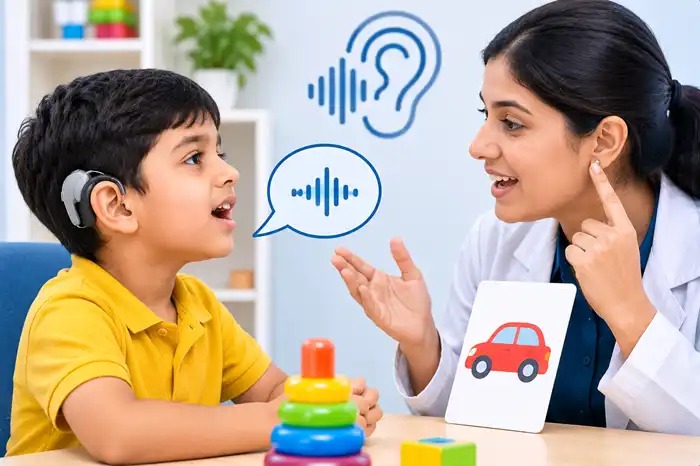
Auditory Verbal Therapy is a method that aims to teach hearing-impaired children listening and speech-language skills.
Its aim is to allow the child to communicate using spoken language.
Auditory-Verbal Therapy can be used by hearing-impaired children with the aid of technology.
Early intervention yields the best results regarding language and communication abilities.
The first few years are very important for developing speech and language skills.
Children who start treatment at an earlier age may have better outcomes.
AVT aims to teach children to rely on their hearing for communication and learning.
Treatment can be customized based on individual hearing needs.
AVT utilizes auditory rehabilitation techniques that are grounded in scientific evidence.
The parent plays a significant part in practicing auditory learning outside sessions.
Therapeutic sessions aim at gradually building listening and language skills.
AVT sessions might include:
Therapy sessions are interactive and adapted depending on the child’s age and skills.
An essential component of auditory rehabilitation is the active involvement of parents.
Parents Contribute to the Therapeutic Process Through:
This intervention technique offers multiple developmental and communication advantages.
A number of children learn age-appropriate spoken language through constant AVT.
Hearing technology is a critical element of auditory rehabilitation interventions.
With the Help of Hearing Technology, It Is Possible to:
Good fitting or programming of hearing aids/cochlear implants is critical for success.
AVT can help children cope with numerous hearing-related communication disorders.
Some Common Disorders Are:
Follow-ups are essential throughout the course of auditory rehabilitation.
Consistent therapy sessions and hearing tests enhance auditory rehabilitation.
LIKITA ENT Hospital is a trusted ENT Centre for Auditory Verbal Therapy (AVT) in Patna, Bihar, India, providing specialized auditory rehabilitation support for children with hearing loss, delayed speech and language development, and communication difficulties associated with hearing impairment. Our ENT specialists focus on comprehensive hearing evaluation, appropriate use of hearing aids or cochlear implants, and individualized rehabilitation planning based on each child’s age, hearing ability, language development, and communication needs. With listening-based activities, speech and language development support, parental guidance, hearing technology assessments, and regular progress monitoring, LIKITA ENT Hospital aims to help children develop listening skills, improve spoken communication, and participate more confidently in learning and social interactions. Active family involvement and consistent follow-up are encouraged to support each child’s individual developmental goals.