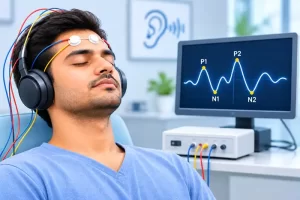
The Pure Tone Audiometry (PTA) test is one of the most significant tests used in audiology and ENT practice to assess patients’ hearing ability and the type and extent of their hearing loss. It is a specialized test used to assess an individual patient’s hearing sensitivity and determine the type, degree, and pattern of hearing loss. It also helps to identify the type of hearing loss (conductive, sensorineural, or mixed).
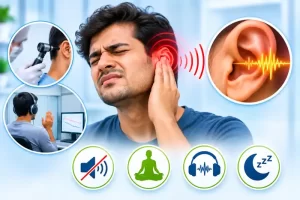
Listening plays an important role in learning, socialization, language acquisition, and communication. Since hearing loss can happen at any point in a person’s life, children, adolescents, adults, and older adults alike can be equally affected. The signs of a hearing problem include tinnitus, ear blockage, difficulty understanding speech, and constantly requesting things to be repeated.
By identifying the lowest audible sound levels at various frequencies, pure-tone audiometry is a safe method for evaluating a patient’s hearing. In a specially constructed audiology room, patients undergo Pure Tone Audiometry using audiometric equipment and specialized headphones. The audiogram, which charts the results, provides audiologists and ENT specialists with information about patients’ hearing capacity.
The procedure is often prescribed to individuals suffering from hearing loss, tinnitus, otitis, vertigo, noise exposure, trauma to the ears, delayed speech development, hearing aid adjustment, and prior to surgical interventions.
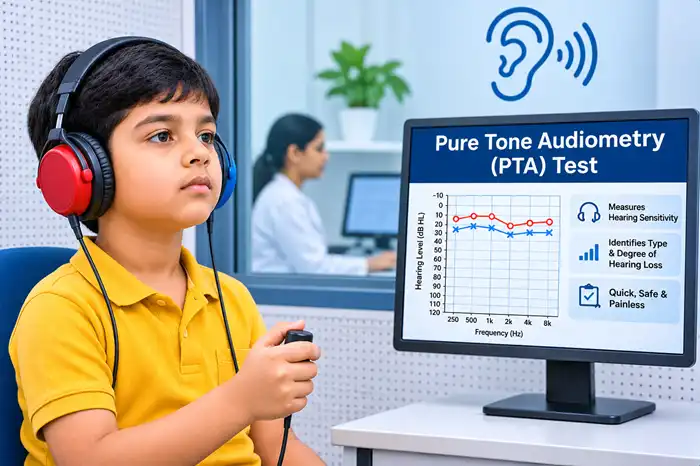
Pure Tone Audiometry is a diagnostic hearing test used to determine hearing thresholds at specific sound frequencies.
The Test enables us to assess:
It is regarded as one of the most precise methods of hearing diagnostics.
PTA should be considered for patients with hearing or ear complaints.
Indications May Include:
Testing for auditory disorders is vital because it enables the timely detection of hearing impairments.
PTA enables the identification of various types of hearing impairments.
Patients might need to undergo an auditory examination due to hearing problems.
Symptoms May Include:
Early testing can avoid further development of any hearing difficulties.
This test is usually administered by an audiologist in a sound-controlled room.
Test Procedure
An audiogram will be used to record the outcomes.
Air Conduction Test: Tests sound passing through the external, middle, and inner ear.
Bone Conduction Test: Measures sound transmission through the inner ear and auditory nerves.
Interpretation of an Audiogram:
Pure Tone Audiometry can be considered a means of obtaining objective information about hearing and the ears.
Some Advantages of the Test Are as Follows:
It is a useful instrument for creating a therapy strategy.
Pure-tone audiometry may be used to diagnose various ENT and audiometric pathologies.
The Most Common Ones Are as Follows:
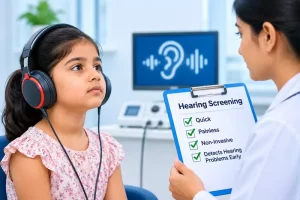
Pure Tone Audiometry is an absolutely safe and pain-free test.
Key Features of Pure Tone Audiometry Are:
Most hearing evaluations take just a few minutes.
In case of hearing loss, a patient may require additional rehabilitation.
Hearing rehabilitation may include:
Correct hearing rehabilitation leads to better communication in the future.
Early hearing examination prevents the development of communication problems.
Benefits of the Earliest Hearing Assessment Include:
A routine hearing examination is vital for people who are at risk of hearing loss.
LIKITA ENT Hospital is a trusted ENT Centre for Pure Tone Audiometry (PTA) testing in Patna, Bihar, India, providing specialized hearing assessment support for children, adults, and older individuals experiencing hearing loss, tinnitus, difficulty understanding speech, ear blockage, or delayed speech and language development. Our ENT specialists focus on comprehensive hearing evaluation, assessment of hearing thresholds in both ears, and identification of possible conductive, sensorineural, or mixed hearing loss based on individual clinical needs. With air conduction and bone conduction testing, audiogram interpretation, hearing aid assessment when indicated, and recommendations for appropriate hearing rehabilitation, LIKITA ENT Hospital aims to support early identification of hearing difficulties and guide informed treatment decisions. Personalized guidance, follow-up recommendations, and coordination with hearing rehabilitation services when required help patients improve communication, support children’s speech and language development, and maintain a better quality of life.