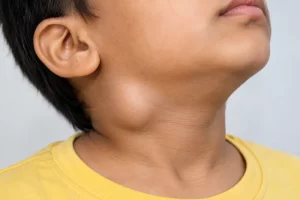
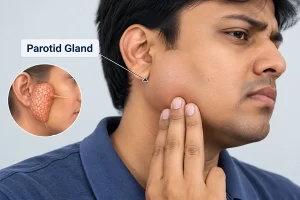
An essential component of the body’s defense system is the lymph nodes. They filter harmful substances, fight disease, and support the body’s overall defense. Although they are distributed throughout the body, the lymph nodes are concentrated in the face, such as under the jaw, behind the ear, and near the collarbone. In ENT, enlarged, swollen lymph nodes in the head and neck region are a significant concern in both children and adults.
A swollen lymph node, medically known as Lymphadenopathy, may indicate an infection, inflammation, or an immune system disease; alternatively, it may be associated with a growth or tumor. Most of the time, an enlarged lymph node is not dangerous and will subside after recovery from a throat, dental, or ear infection, or any viral infection. However, any enlarged node that persists for some time without pain or tenderness, grows quickly, or is hard may indicate the need for further investigation, as it could represent Tuberculosis, Lymphoma, or a Metastatic Cancer.
Since a disordered lymph node may indicate an ENT condition as well as a systemic condition, a thorough medical examination and prompt diagnosis are vital to ensure you receive effective treatment and prevent complications later.

Malignancy, inflammation, or infection can cause swollen lymph nodes.
Common causes are:
The cause of the swelling affects how large, firm, and long the lymph nodes remain swollen.
Symptoms of enlarged lymph nodes vary from one condition to another, depending on the underlying cause of the disorder:
Any hard, painless, or growing lump in the neck should be investigated by a doctor immediately.
Lymph node disorders can be broadly categorized as:
The diagnostic process involves an extensive examination to determine the cause of swollen lymph nodes.
The process may include:
These investigations help the ENT specialist arrive at an accurate diagnosis, whether it’s an infection, inflammation, or any other type of growth.
The treatment depends on the underlying reason for lymph node swelling.
Certain small reactive lumps can resolve and heal on their own over time.
If the cause is a tumor or a persistent or suspicious lump, it may need to be removed surgically or biopsied.
Surgical procedures might include:
Modern surgical techniques, combined with specialist care, enable accurate diagnosis and treatment while minimizing complications and ensuring patient safety.
Untreated or delayed treatment of lymph node disorders can have detrimental consequences.
Potential Complications may include:
Prompt diagnosis of the underlying cause is crucial for promoting a quicker recovery and preventing life-threatening complications.
While some lymph node disorders can be prevented, others cannot, but they can be managed through early treatment of any infection.
Prevention Strategies Include:
Taking preventative measures will greatly lower the likelihood of difficulties, resulting in a much better quality of life.
Most patients with lymph node disorders recover quickly and effectively once treatment is initiated.
Key advice for the patients:
A positive prognosis for these ailments is based on the successful use of medication and surgery, providing hope for recovery.
Last Updated: September 15, 2026
Likita ENT Hospital offers safe and effective Lymph Node Disorder Treatment in Patna, Bihar, India, at an affordable cost. Our team of experienced ENT specialists provides accurate neck examination and diagnostic assessment to identify the cause, size, location, and nature of enlarged or abnormal lymph nodes and evaluate their possible relation to surrounding ENT conditions. Treatment is tailored according to the patient’s age, symptoms, duration of swelling, underlying cause, and individual needs. When required, our ENT specialists can manage associated neck swelling, pain, tenderness, infection, inflammation, or persistent lymph node enlargement and recommend suitable medical treatment, imaging, biopsy, or surgical management when appropriate. With advanced ENT diagnostic facilities, experienced specialists, and a patient-focused approach, Likita ENT Hospital is committed to providing safe, precise, and comfortable Lymph Node Disorder Treatment in Patna, Bihar, India.