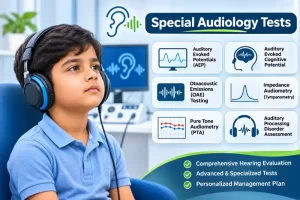
Auditory Evoked Cognitive Potentials (AECP) are sophisticated audiological tests utilized to investigate auditory processing and cognitive function in response to auditory stimulation. In contrast to general hearing assessments, which merely test an individual’s hearing threshold or ability to detect sound, AECPs are more advanced tests that assess the brain’s ability to recognize, discriminate, understand, and interpret auditory stimuli. So, AECP testing is extremely useful in evaluating an individual’s auditory perception, attention, memory, language processing, and auditory nervous system functioning.
The process of hearing is intricate and requires multiple processes, from the ear to various areas of the brain. While a person may have normal hearing, he/she could experience problems with comprehending sounds, focusing on sounds, interpreting language, or distinguishing between two auditory stimuli. These functions require the involvement of various centers within the brain. AECPs are useful for diagnosing abnormal functioning along these neurological pathways.
This test is particularly helpful in evaluating cases involving disorders such as central auditory processing disorders, speech and language delays, learning disabilities, attention-deficit disorders, autism spectrum disorders, auditory neuropathy, neurologic disorders, cognitive dysfunction, tinnitus, and auditory rehabilitation monitoring. They are also being increasingly employed in research and high-end auditory neuroscience.
The Auditory Evoked Cognitive Potential tests frequently performed are:
Each of these two tests assesses cognitive processing in higher auditory centers.
There is absolutely no risk involved in the test, as it is entirely safe, painless, and non-invasive. To monitor the brain’s electrical activity in response to sounds played through earphones, tiny electrodes are affixed to the scalp. The test’s objective nature makes it useful for people who cannot communicate verbally.
Highly sophisticated neuro-audiology facilities use state-of-the-art computerized cognitive auditory systems to give precise measurements of auditory processing and brain responses.

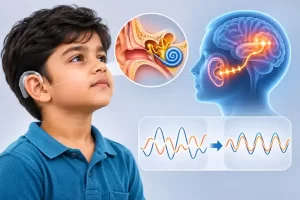
Auditory Evoked Cognitive Potentials are the electrical potentials generated in the brain during the brain’s processing of auditory information.
The Tests Measure:
This test will help us understand how the brain processes sounds beyond hearing them.
The test is useful for identifying auditory processing and cognitive problems that might remain undetected by traditional hearing assessments.
The Tests Help In:
Objective measurement of the brain’s processing of sounds can be obtained through tests.
Mismatch negativity (MMN) is a complex auditory cognitive potential of the brain that assesses the automatic discrimination of the difference between auditory stimuli.
The test is conducted using repeated standard sounds, along with infrequent and varied sounds termed “deviant stimuli,” and the brain’s automatic reaction is measured using scalp electrodes.
MMN tests pre-attentive auditory perception, which refers to the brain’s ability to automatically detect differences in sound without conscious attention.
MMN testing is useful in pediatric neuro-audiology and cognitive auditory assessment.
P300 is a cognitive auditory evoked potential that tests attention, auditory memory capacity, decision making, and high-level sound cognitive processing.
Unlike MMN, P300 requires active patient participation, as the subject must recognize a particular sound.
The patient hears many standardized stimuli, along with target stimuli, at irregular intervals. The brain produces a distinct response, known as the P300 response, when target stimuli are detected.
P300 test measures:
P300 tests provide valuable information about higher auditory and cognitive brain functions.
Active participation may be required during P300 testing but not during MMN testing.
General Advantages Include:
These tests are widely used in contemporary neuroradiology and cognitive audiometry.
Cognitive potential tests can be very useful for children and adults suffering from speech disorders.
These Tests Can Be Used:
Evaluation of auditory cognition helps improve speech, academic performance, and neurological development.
Benefits of Early Evaluation Include:
Cognitive auditory evaluation is essential for individuals with hearing or nervous system issues.
LIKITA ENT Hospital is a trusted ENT Centre for Auditory Evoked Cognitive Potential (AECP) testing and neuro-audiological evaluation in Patna, Bihar, India, providing specialized assessment for individuals experiencing auditory processing difficulties, speech and language delays, listening problems, and challenges with auditory attention or sound discrimination. Our ENT specialists focus on comprehensive hearing evaluation, appropriate selection of cognitive auditory tests, and individualized assessment based on each patient’s symptoms and clinical needs. With diagnostic approaches such as Mismatch Negativity (MMN) and P300 testing when indicated, detailed interpretation of auditory brain responses, and coordination with audiology, speech-language therapy, and rehabilitation professionals when required, LIKITA ENT Hospital aims to support a better understanding of auditory processing difficulties and guide appropriate care. Each evaluation is tailored to the patient’s age, communication abilities, and clinical requirements, with follow-up recommendations based on the findings.