Otoacoustic emissions (OAEs) are sophisticated hearing tests that assess the function of the inner ear. The main parts evaluated by OAEs are the cochlea and outer hair cells, which are involved in hearing. According to many experts, OAEs are among the most effective methods for diagnosing hearing impairment in infants, children, and adults. Hearing loss may be detected at an early age using OAEs before it causes any speech or communication difficulties.
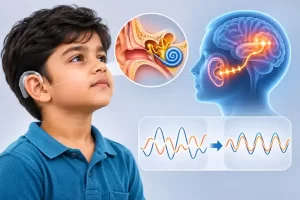
Conversion of auditory vibrations into neural signals occurs in the cochlea of the inner ear. OAE is an acoustic emission that arises when the cochlear outer hair cells function properly. The efficiency of this process can be checked using sophisticated instruments.
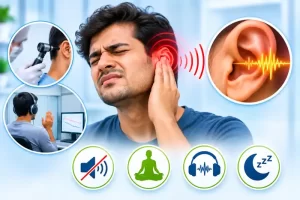
OAEs are quick, reliable, and painless, so they are widely used in newborn hearing screening. OAEs can assist in identifying hearing loss, tinnitus, noise-induced hearing loss, auditory dysfunction, speech delay, otitis media, and possible cochlear nerve problems.
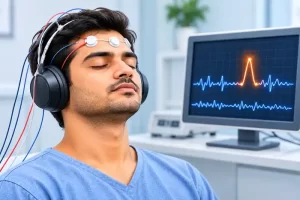
This procedure is painless and comfortable. First, a small probe is inserted into the ear canal. Then, sounds are provided. The instrument automatically records the inner ear’s response to them. This procedure is suitable for all ages because no patient interaction is required for diagnosis.
Audiology clinics today use highly sophisticated OAE equipment to test patients’ hearing capacity and formulate a treatment plan accordingly. Early diagnosis and treatment for hearing loss can positively affect speech and learning.
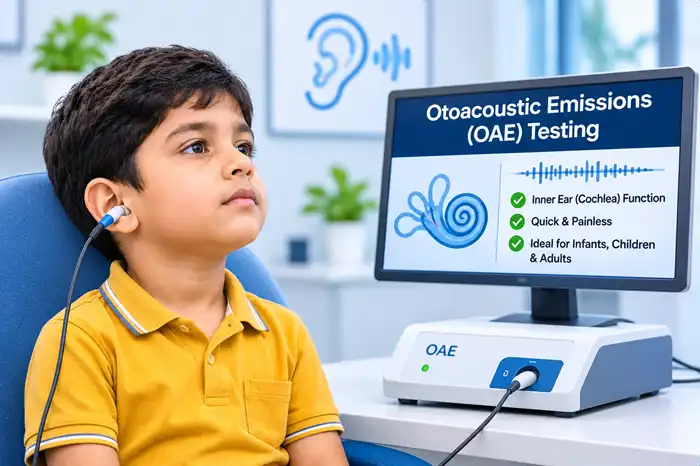
These emissions include small sound signals from normal cochlear outer hair cells in reaction to sound stimulation.
OAE Testing Can Be Used To Diagnose:
This test will help to understand how well the cochlea works.
There are several kinds of OAE testing depending on the type of problem.
OAE tests can be administered to individuals of all ages.
Some Possible Reasons for Testing Include:
This test can be performed when patients are not able to participate in conventional hearing tests.
Identifying hearing disorders in newborns at an early age plays an important role in healthy language acquisition.
Advantages of Early Detection:
This test can be used to identify hearing impairment at early stages of development in newborns.
There are some indications that patients might need an OAE test.
Common Symptoms include:
An early ear examination helps achieve good communication results.
OAE testing is a rapid and non-invasive test.
Test Description
The test takes just a few minutes and does not involve any pain.
OAE testing offers many advantages for assessing cochlear function.
Common Advantages Include:
The test can contribute to preventive healthcare measures.
Many conditions can be detected during an OAE test.
Some of These Conditions Are As Follows:
Further hearing tests will be prescribed if needed.
There are no risks associated with OAE testing.
Some Main Features of the Procedure Are As Follows:
Newborn babies usually cope with the OAE test comfortably.
Patients with hearing abnormalities may need additional rehabilitation.
Rehabilitation Services Include:
Early treatment plays a major role in speech development.
A correct hearing diagnosis is key to future communication skills.
Benefits of Early Hearing Diagnosis:
Hearing tests have a key role in preventive hearing care.
Last Updated: November 3, 2026
LIKITA ENT Hospital is a trusted ENT Centre for Otoacoustic Emissions (OAE) testing in Patna, Bihar, India, providing specialized hearing assessment support for newborns, infants, children, and adults who may have hearing difficulties, delayed speech development, or concerns about inner ear function. Our ENT specialists focus on appropriate hearing screening, evaluation of cochlear function, and individualized diagnostic recommendations based on each patient’s age, symptoms, and clinical needs. With OAE testing methods such as Transient Evoked Otoacoustic Emissions (TEOAE) and Distortion Product Otoacoustic Emissions (DPOAE), when indicated, LIKITA ENT Hospital aims to support early identification of potential hearing problems and guide further audiological evaluation when necessary. Personalized guidance, timely referral for hearing rehabilitation, and follow-up recommendations help patients and families take informed steps toward better hearing, speech and language development, and communication outcomes.