The most common reason babies breathe noisily is laryngomalacia, which involves the relaxation of soft tissues above the voice box (larynx) that fold into the airway, restricting airflow. Usually, such patients experience stridor, a whistling sound that worsens when the child feeds, cries, sleeps, or is placed supine.
The disease manifests soon after birth or develops in the first months of a baby’s life. In many children, laryngomalacia is mild, and the breathing problem resolves without intervention as the laryngeal structures mature. Still, moderate or severe forms of the disease may be accompanied by feeding difficulties, poor weight gain, breathing problems, disrupted sleep, and low oxygen saturation.
Breathing and eating are two functions that are connected in babies. Thus, it is very important to visit an otolaryngologist and ensure an accurate diagnosis and normal physical development.
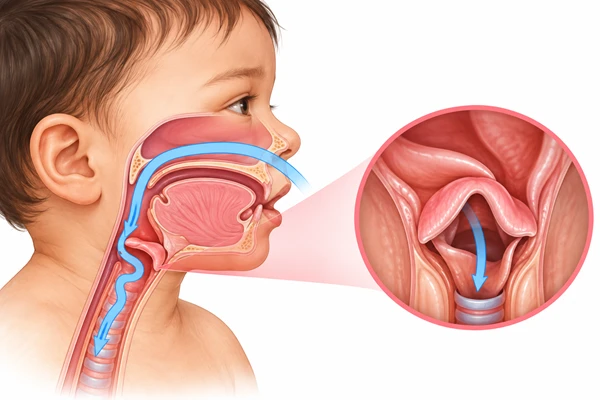
Laryngomalacia arises due to weak or underdeveloped tissues around the larynx.
Possible Causes and Contributing Factors Include:
The cause is not precisely known, but the condition is innate, present from birth.
Loud breathing and other symptoms often occur during feeding, crying, or when the infant is lying on their back.
Common Symptoms Include:
Symptoms can be exacerbated by colds or respiratory diseases.
Laryngomalacia is categorized based on severity.
An accurate diagnosis helps determine airway functioning and exclude other causes of breathing noises.
Diagnostic Techniques Include:
These tests allow ENT specialists to determine the severity of the disorder and its treatment options.
The therapy of laryngomalacia depends on the severity of symptoms and the extent of airway obstruction.
Most cases resolve by 18-24 months of age and require only monitoring.
The failure to treat the condition leads to complications with breathing, feeding, and growth problems.
Complications that May Arise Include:
Prompt intervention prevents any possible serious problems with the airways.
Laryngomalacia is a birth problem and, therefore, there is no way to prevent it. Early detection and monitoring are vital.
Some of the Essential Steps Are:
Follow-up for monitoring breathing and growth helps ensure safe airway management and healthy growth.
For most infants with this disorder, symptoms will gradually improve over time.
Some of the Important Things Parents Should Do Are:
Parents should consult a doctor immediately if severe breathing problems arise.
Likita ENT Hospital offers safe and effective Laryngomalacia Treatment in Children in Patna, Bihar, India, at an affordable cost. Our team of experienced ENT specialists provides accurate airway and throat examination and diagnostic assessment to identify laryngomalacia and evaluate its effect on the child’s breathing, feeding, and overall airway function. Treatment is tailored according to the severity of symptoms, age of the child, feeding and breathing difficulties, and individual needs, with appropriate monitoring for mild as well as more significant cases. When required, our ENT specialists can manage associated noisy breathing, feeding difficulties, choking, poor weight gain, breathing problems, or sleep-related symptoms and recommend suitable observation, medical management, or surgical treatment, including supraglottoplasty when appropriate. With advanced ENT diagnostic facilities, experienced specialists, and a child-focused approach, Likita ENT Hospital is committed to providing safe, precise, and comfortable Laryngomalacia Treatment in Children in Patna, Bihar, India.