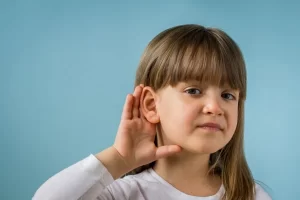
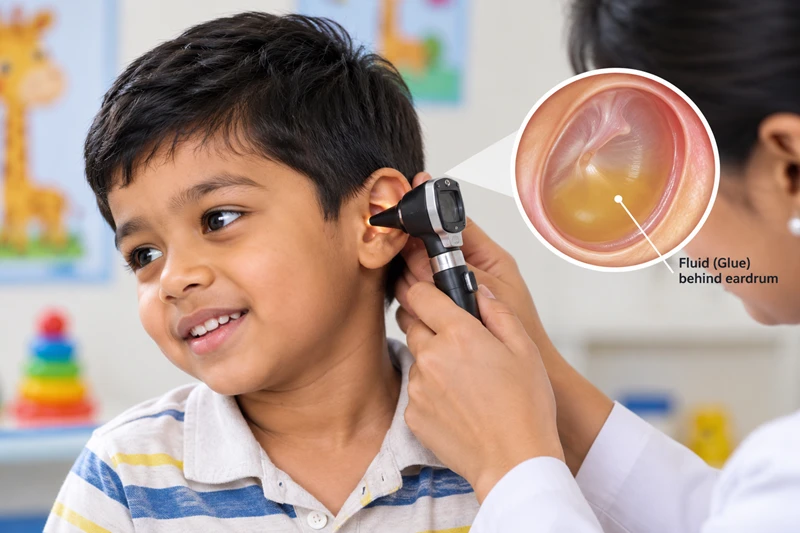
OME (Otitis Media with Effusion), or “Glue Ear” as it’s known, is the accumulation of fluid in the middle ear with no signs of infection. The middle ear is the air-filled space beneath the eardrum, filled with a viscous fluid that can interfere with hearing and may also cause ear fullness.
Glue ear is one of the most frequently seen ENT conditions in children, especially in younger children, and often follows on from a number of childhood conditions, e.g., middle ear infections, colds, allergies, or nasal airway obstruction caused by adenoidal hypertrophy. Because it presents with difficulty in hearing rather than with pain, it can be relatively difficult to identify.
In the absence of treatment, glue ear may result in difficulties with speech, learning, concentration, and communication. It is vital that an ENT specialist diagnoses this condition to treat hearing loss and avoid complications.
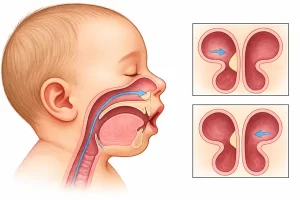
The Eustachian tube, which joins the middle ear to the back of the nose, can cause glue ear if it does not function properly.
Common Causes of glue ear include:
Younger children tend to have glue ear more often because their Eustachian tubes are shorter and more easily blocked.
At first, symptoms may be hard to identify, and the signs can be quite subtle.
Common Signs and Symptoms of glue ear include:
A child with glue ear may often seem inattentive or unresponsive simply because they cannot hear what people are saying to them.
The type of glue ear may vary with respect to its duration and severity:
Glue ear can occur on both sides (bilateral), and it may appear more pronounced as the child finds hearing quite difficult. By understanding just how long the child has had a build-up of fluid behind the ear and just how bad it actually is, a doctor may be able to determine whether or not the child requires surgery.
Diagnosis of the condition is really important, as hearing loss from glue ear can impede a child’s speech and learning. When looking to diagnose, Doctors use:
An ENT consultant can obtain highly accurate evidence of how hearing and middle ear function have been affected through this assessment.
The severity of the condition determines how it is treated, the duration, and the impact on the child’s hearing.
In mild cases, the fluid may resolve without treatment, though it will be monitored regularly.
Management involves treating underlying conditions, allergies, and nasal congestion. Nasal steroid sprays can be useful in certain cases of glue ear. Recurrent infections need to be managed and hearing monitored along with other supportive treatment.
Surgery may be required if hearing remains impaired, which will have a significant impact on the child’s speech and learning. A grommet insertion may be required, as may the removal of enlarged adenoids that are contributing to a blocked airway. A grommet ensures ventilation of the middle ear by providing a tube through the eardrum, allowing the fluid behind it to escape.
A child with speech delay and hearing impairment will receive additional therapy from professionals and use hearing aids.
Hearing & speech development could be delayed.
Other potential complications of chronic glue ear include:
If the problem is treated, the child’s hearing can recover and develop normally.
Some methods may help reduce the likelihood of glue ear:
Treating infections at an early stage, treating allergies, avoiding smoking, and ensuring children are vaccinated. Regularly have the child’s hearing assessed if the child experiences frequent ear problems, and promptly have any suspected hearing or speech delay assessed by an ENT specialist.
It can be assumed that, for many children, hearing will improve and develop, provided treatment is properly undertaken alongside hearing support. It is very important to regularly monitor a child’s hearing and speech development. Engage in ongoing conversation, interact socially, have the child undergo regular hearing tests, and follow medical advice to surgically improve the child’s hearing or to pursue rehabilitation. Attend all follow-up appointments. It may be assumed by now, and after reading about its effects and treatment, that it is important for children with a problem to be assessed promptly.
Likita ENT Hospital offers safe and effective Otitis Media with Effusion (Glue Ear) Treatment in Children in Patna, Bihar, India, at an affordable cost. Our team of experienced ENT specialists provides accurate ear examination, hearing evaluation, and diagnostic assessment to identify fluid buildup behind the eardrum and assess its effect on the child’s hearing and ear health. Treatment is tailored according to the child’s age, duration and severity of the condition, hearing status, recurrent ear problems, and individual needs. When required, our ENT specialists can manage associated hearing difficulties, recurrent ear infections, Eustachian tube dysfunction, persistent middle-ear fluid, or related developmental concerns and recommend suitable medical or surgical treatment, including ventilation tube placement when appropriate. With advanced ENT diagnostic facilities, experienced specialists, and a child-focused approach, Likita ENT Hospital is committed to providing safe, precise, and comfortable Otitis Media with Effusion (Glue Ear) Treatment in Children in Kankarbagh, Patna, Bihar, India.