Salivary stones (sialolithiasis) are hard lumps of mineral that form in your salivary glands or the tubes (ducts) leading from the glands to the mouth. They can block saliva from reaching your mouth, leading to swelling, pain, infections, and difficulty eating and swallowing. They are very commonly found in glands in the lower jaw beneath the chin (submandibular glands), as well as in glands near the ears (parotid glands) and even in tiny glands within the mouth.
It is impossible to overstate the importance of saliva in the digestive process, mouth hydration, and infection prevention. Because the glands enlarge in response to excessive salivation, particularly during eating when saliva flow increases, the production of salivary stones irritates the glands.
They are found in all ages, though adults are more commonly affected. It is important that they are diagnosed and treated by ENT services when necessary so that pain, swelling, and infections are relieved and there is no permanent damage to the glands.
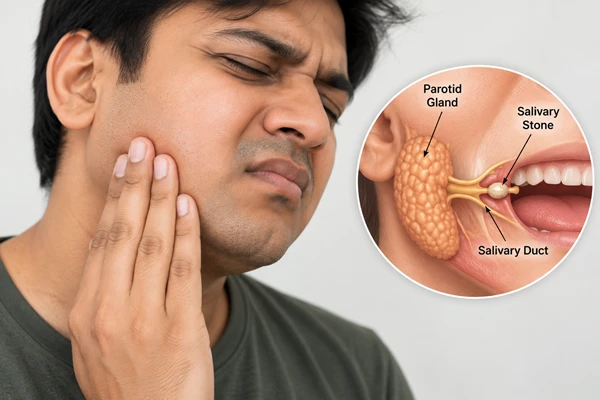
Salivary calculi are deposits of minerals in the salivary ducts. Factors that lead to this condition include:
Symptoms depend on the stone’s size and position. Possible symptoms include:
Symptoms can come and go, particularly if the stone partially blocks the duct.
The type of salivary stone is identified by where it has developed:
The position and size of the stone will affect how it is treated.
Accurate diagnosis is essential to determine the location and severity of the blockage.
The methods used in diagnosis include:
ENT specialists can determine the best course of action.
Treatment depends on where the stone has formed, its size, and the symptoms it causes.
Small stones may be passed with simple supportive treatment:
ENT surgeons can use the very latest minimally invasive techniques that remove the stone without any major surgery:
Large stones, recurrent or infected glands, or other conditions may require surgical removal. Modern surgical techniques aim to preserve the glands where possible.
Stones left untreated will lead to recurrent gland infections. Other potential complications include:
Salivary stones can be prevented by:
If symptoms of recurring gland infection recur, it would be wise to attend for a routine medical assessment.
Most patients make a full recovery after treatment to remove salivary stones. Patients can:
Likita ENT Hospital offers safe and effective Salivary Stone Treatment in Patna, Bihar, India, at an affordable cost. Our team of experienced ENT specialists provides accurate examination and diagnostic assessment to identify the size, location, and number of salivary stones and evaluate their effect on salivary gland function. Treatment is tailored according to the size and location of the stone, severity of symptoms, affected gland, presence of infection, and individual patient needs. When required, our ENT specialists can manage associated gland swelling, pain, difficulty eating, reduced saliva flow, infection, or recurrent salivary gland problems and recommend suitable medical, minimally invasive, or surgical treatment for stone removal when appropriate. With advanced ENT diagnostic facilities, experienced specialists, and a patient-focused approach, Likita ENT Hospital is committed to providing safe, precise, and comfortable Salivary Stone Treatment in Patna, Bihar, India.