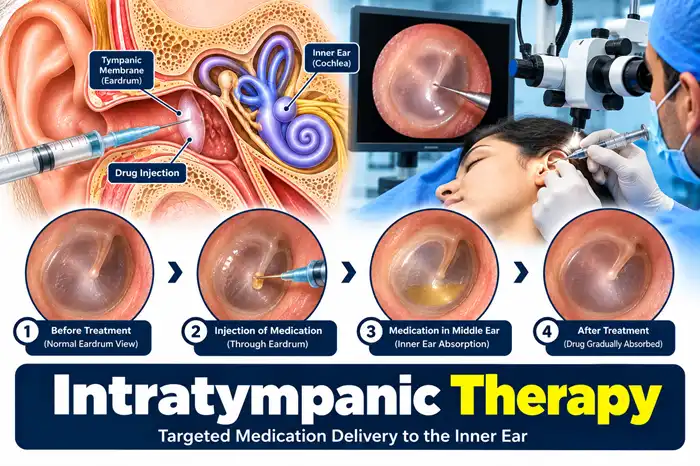
Intratympanic treatment refers to a surgical ENT procedure that entails injecting medicine into the middle ear through the eardrum. The goal of this procedure is to treat inner-ear diseases that affect hearing and balance. Injection of drugs directly into the ear helps deliver them to specific structures and reduces the potential side effects of systemic treatments.
This method is commonly used to manage conditions such as sudden sensorineural hearing loss, Meniere’s disease, vertigo, autoimmune inner ear diseases, tinnitus, and certain inflammatory conditions affecting the inner ear. Intratympanic therapy is normally carried out as an outpatient procedure and involves an injection of medications such as steroids or gentamicin into the middle ear space using microscopic guidance.
Within the inner ear, there are delicate structures, both the organs for hearing and the organs responsible for our balance, and so, by administering a drug directly to this region, it is much more effectively able to combat the inflammation, control vertigo attacks, maintain our hearing function, and improve the symptoms in a selected range of patients.
Intratympanic therapy has recently been considered an essential tool within the specialty of neuro-otology due to being minimally invasive, largely pain-free, and also the fact that it is highly effective in managing symptoms without the need for more major surgery.
The inner ear consists of delicate structures responsible for both hearing and balance.
These structures include the cochlea and the vestibular system:
Any disorder of the inner ear can cause hearing problems, balance issues, vertigo, and tinnitus.
Intratympanic therapy is indicated for patients who have specific disorders of hearing and balance that may be unresponsive to normal medication therapy.
Examples of common indications include:
Selection for this procedure is tailored for the diagnosis of hearing and balance.
Patients undergoing intratympanic therapy usually present with hearing or balance symptoms:
Sudden or persistent inner ear symptoms should be promptly investigated by an ENT specialist.
Before proceeding to intratympanic therapy, it is critical that the diagnosis of an inner ear problem is confirmed.
The process involves:
Intratympanic therapy is usually carried out in an outpatient setting under local or topical anesthesia.
The process of intratympanic therapy:
Intratympanic therapy generally takes less than 10 minutes and is a minimally invasive procedure.
The medications used are most commonly either:
Following treatment, the patient is usually able to return to work shortly afterward.
Recommendations post-treatment include:
Many patients require repeat intratympanic therapy procedures.
The benefit of intratympanic therapy is that it administers medicine right to the site of the illness. allowing treatment at the source and thereby avoiding the systemic side effects that are typically encountered with oral medication.
The key advantages are:
Patients often notice an improvement in hearing and balance soon after commencing this form of therapy.
It is possible for the following side effects/complications to occur, although intratympanic therapy is generally a very safe procedure:
Good technique and care after intratympanic therapy will reduce the incidence of these complications.
Hearing difficulties may need continuous follow-up and rehabilitation. This would involve:
Follow-up under ENT will aid hearing and balance rehabilitation.
LIKITA ENT Hospital is a trusted ENT Centre for Intratympanic Therapy in Patna, Bihar, India, providing specialized evaluation and treatment for sudden sensorineural hearing loss, Meniere’s disease, recurrent vertigo, tinnitus, autoimmune inner ear disorders, and other conditions affecting hearing and balance. Our experienced ENT specialists use detailed ear examinations, hearing assessments, vestibular testing, and appropriate microscopic or endoscopic techniques to deliver medication directly into the middle ear while minimizing unnecessary systemic exposure. With accurate diagnosis, individualized treatment planning, targeted intratympanic treatment, hearing and balance monitoring, and dedicated follow-up care, LIKITA ENT Hospital focuses on managing vertigo, supporting hearing function, reducing inner-ear symptoms, promoting safe recovery, and improving long-term hearing and balance outcomes.