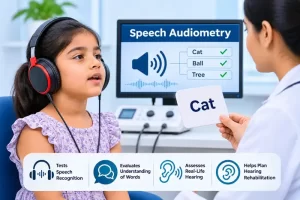
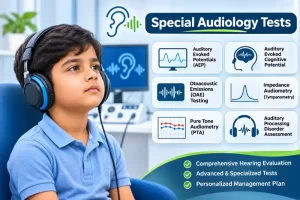
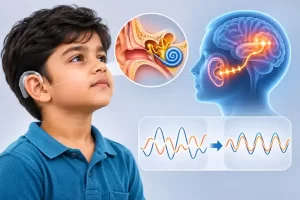
Auditory Evoked Potentials (AEPs) are sophisticated neuro-audiological diagnostic procedures used to examine sound conduction along various segments of the auditory pathway, from the inner ear to the brain. These high-tech diagnostics analyze the electrical responses of the auditory apparatus to sound stimuli. Auditory Evoked Potentials prove essential for the diagnosis of hearing disorders, auditory nerve pathology, neurological disease, central auditory processing disorders, and speech development delay.
Hearing depends on much more than just the ear itself. The moment sound enters the ear and reaches the cochlea, electrical signals travel along the auditory nerve, brainstem, midbrain, and auditory cortex, where they are interpreted and perceived. Any disturbances in this pathway might affect hearing, speech comprehension, communication skills, balance, and even neurological status. AEPs enable ENT doctors, audiologists, and neurologists to detect such abnormalities.
Such procedures are extremely helpful for neonatal hearing tests, pediatric audiology, testing difficult patients, cochlear implant candidacy assessments, neurological examinations, tinnitus investigations, auditory processing disorders, and auditory pathway monitoring during surgery or rehabilitation.
The Auditory Evoked Potential examination procedure is harmless, pain-free, and non-invasive. Electrodes for recording are positioned around the ears and on the scalp, where the brain records responses to sound stimulation. Because the test is non-verbal, it is the best way to assess children, infants, comatose individuals, or people unable to participate in a traditional hearing test.
Sophisticated computer-based AEP systems are currently used in modern neuro-audiological practice to comprehensively assess the hearing mechanism at various levels of the nervous system.
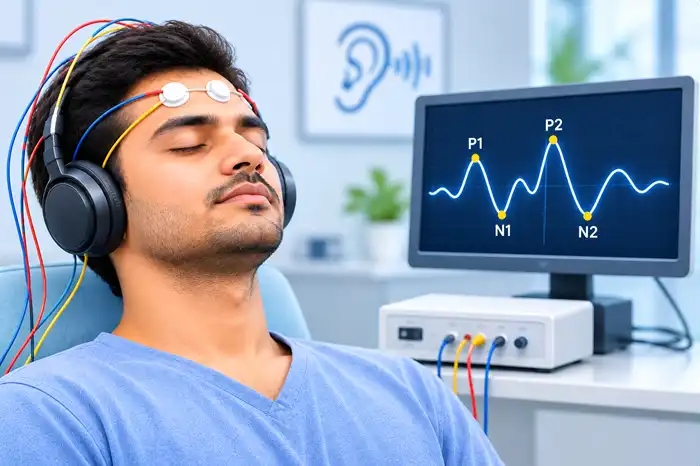
Auditory Evoked Potentials are responses from the hearing pathway to auditory stimulation.
The Following Are Evaluated by AEP Testing:
AEP tests are conducted to diagnose any problems related to auditory perception.
AEP tests can assist in detecting disorders within the hearing pathway.
Tests Used For:
These tests help gather information on sound transfer through the nervous system.
Auditory Evoked Potentials can be grouped according to the specific auditory pathway that is being tested.
Auditory Nerve Evoked Potentials are used to measure the transfer of the sound signal from the cochlea to the auditory nerve. Electrical impulses are sent from the inner ear to the brainstem via the auditory nerve.
Problems with the auditory nerve could result in hearing loss, difficulties comprehending speech, ringing in the ears, or auditory neuropathy.
This kind of testing is very beneficial for infants and for people who are difficult to examine.
The process of measuring electrical impulses sent to the brain via auditory pathways in response to sound stimuli is called auditory brainstem response testing, or brainstem auditory evoked response test.
ABR is achieved using electrodes attached to the scalp that monitor the auditory pathway’s response to clicks delivered via earphones.
ABR is one of the most popular objective hearing examinations in current audiology and neuro-otology.
ABR evaluation is an important part of pediatric hearing screening programs.
Auditory Evoked Potentials of the Midbrain measure how the midbrain processes sounds, particularly in the areas responsible for perceiving high-frequency sound.
The auditory midbrain assists in integrating auditory localization, auditory attention, and sound reflexes.
Impaired midbrain function may affect how sound information is interpreted and processed, even when hearing function remains normal.
Auditory Cortex Evoked Potentials test the brain’s auditory cortex and its ability to interpret sounds and process auditory information. The auditory cortex helps identify sounds consciously and understand speech.
Although there is no hearing problem, problems with auditory cortex processing can affect speech, language comprehension, and learning abilities.
Testing the auditory cortex allows researchers to study how the brain processes auditory information.
The procedures are generally painless and performed in quiet diagnostic settings.
Popularly Known Benefits Are:
Auditory evoked potential tests are a vital part of current neuro-audiology and hearing rehabilitation.
Proper diagnosis can ensure good hearing, language, and communicative skills in the future.
The importance of Early Testing is:
It is important for children and adults suffering from hearing and/or communication disorders.
Dr. Narendra Krishna Yadav
Last Updated: November 2, 2026
LIKITA ENT Hospital is a trusted ENT Centre for Auditory Evoked Potentials (AEP) testing in Patna, Bihar, India, providing specialized assessment of hearing pathways and auditory nerve responses in newborns, infants, children, and adults who require objective hearing evaluation. Our ENT specialists focus on comprehensive hearing assessment, appropriate selection of auditory evoked potential tests, and individualized diagnostic evaluation based on each patient’s age, symptoms, and clinical needs. With tests such as Auditory Brainstem Response (ABR) and Brainstem Auditory Evoked Response (BAER) when indicated, careful interpretation of auditory responses, and personalized recommendations for further investigations or hearing rehabilitation, LIKITA ENT Hospital aims to support accurate assessment of hearing function and guide appropriate care. Each evaluation is tailored to the patient’s condition, with follow-up recommendations based on the findings and individual hearing needs.