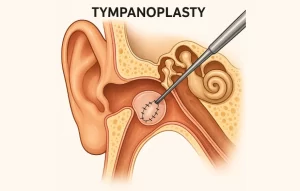
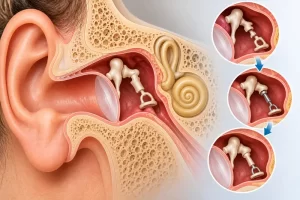
Stapedotomy is a minor ear surgery used to restore hearing in people with hearing loss due to otosclerosis (abnormal bone growth that prevents the middle ear’s stapes, a tiny bone, from vibrating. The stapes, incus, and malleus are three extremely small hearing bones found in the ear. These three small bones connect to the inner ear to transmit sound waves. Otosclerosis causes the stapes to become locked, reducing the inner ear’s ability to transmit sound waves. The result is a conductive hearing loss.
Stapedotomy is one of the best types of surgery to treat hearing loss in people with conductive hearing loss and stapes fixation due to otosclerosis. During stapedotomy surgery, a very small hole is drilled in the stapes footplate, and a very small piston prosthesis is inserted to connect the stapes to the inner ear and restore sound conduction. The surgery will improve your hearing clarity, your ability to hear and understand conversations, and your communication abilities.
Modern laser-assisted stapedotomy surgery makes the procedure safer and can achieve better hearing outcomes. Most people will achieve much better results than with earlier surgical techniques. Patients will usually regain some useful hearing after surgery, and most can return to everyday life with improved hearing.
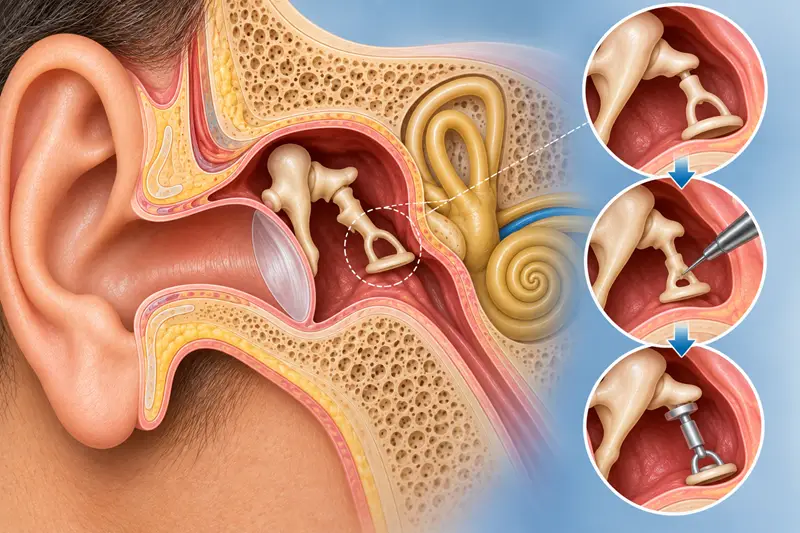
Otosclerosis is an abnormal remodeling condition affecting the stapes or other ossicles.
The disease usually has a gradual onset and occurs in the young and middle-aged.
Stapedotomy may be recommended for patients with conductive hearing loss and stapes fixation.
A detailed hearing assessment will help determine the appropriateness of surgery.
Otosclerosis can cause gradual hearing loss.
Early diagnosis by an ENT specialist is key to optimal management.
An accurate diagnosis is essential prior to performing stapedotomy surgery.
A number of these tests are required to establish the degree of conductive hearing loss and demonstrate stapes fixation.
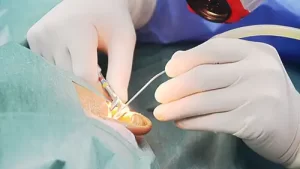
Operating microscopes are required for this treatment, which is usually performed under local or general anesthesia.
Modern techniques use lasers to create a tiny fenestration in the footplate, reducing trauma to the delicate ossicular chain and the tympanic membrane. The procedure will usually be performed without an external incision.
Patients should experience a relatively speedy recovery over the following several weeks.
Patients can often notice some improvement in hearing within days or weeks of the surgery.
The potential benefits of stapedotomy include restoring hearing to a functionally useful level for suitably selected patients.
For conductive hearing loss, most patients gain a significant benefit with appropriate case selection and stapedotomy.
Although it is a safe procedure, there is a risk of complications.
Patients can get a higher success rate and lower complication rate by selecting suitable candidates, employing modern methods, and providing the best possible postoperative care.
After regaining good health, patients can return to their normal lives.
Long-term hearing results after stapedotomy are excellent for most patients, and many should enjoy a full quality of life.
LIKITA ENT Hospital is a trusted ENT Centre for Stapedotomy in Patna, Bihar, India, providing specialized evaluation and surgical treatment for otosclerosis, stapes fixation, and conductive hearing loss. Our experienced ENT surgeons use advanced operating microscopes, modern laser-assisted techniques, and appropriate prosthetic technology to perform precise stapedotomy surgery. With comprehensive hearing assessment, individualized treatment planning, advanced surgical techniques, and dedicated postoperative follow-up, LIKITA Hospital focuses on safe treatment, hearing improvement, smooth recovery, and long-term hearing outcomes for patients with otosclerosis.